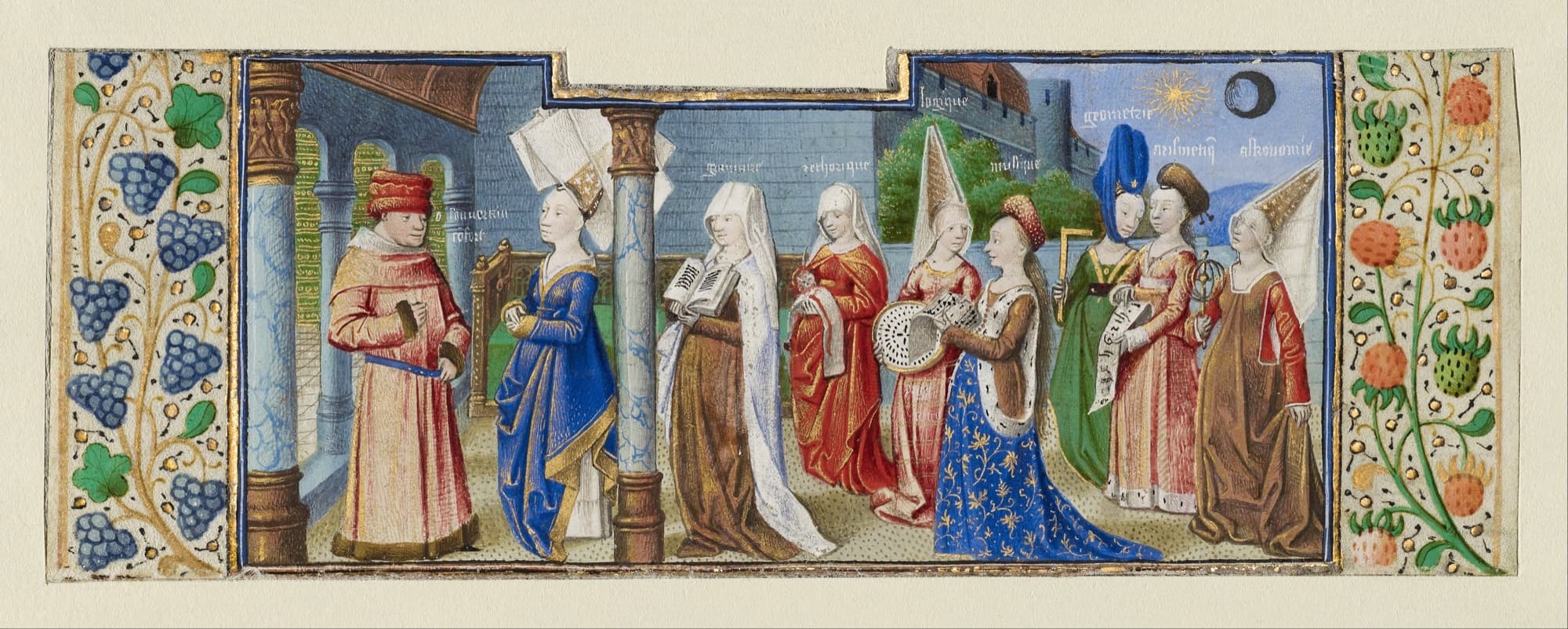
Coëtivy Master (Henri de Vulcop?), Philosophy Presenting the Seven Liberal Arts to Boethius (c. 1460–70). Public domain, via Wikimedia Commons.

How does the finite mind come to reckon with not just the infinitude of things in the world but also the infinitude of ways to verbalize each of those individual things? How does it start, how does it proceed, where does it end (if at all)?
It is by no means a novel question.
Boethius opens his commentary on Aristotle's Categories by framing the Aristotelian logic as an attempt to grapple with this exact question.
Much of medieval scholasticism and the famous problem of universals is arguably downstream from the framing of this problem.
Nor would it die there.
The early Enlightenment would reinvent the issue, so too would German Idealism. With their distinct flavors.
One aspect of this question is the systematic nature of thought and reality. One thought may come after another temporally. From there, many would argue there is a logical ordering. What is the nature of such order and sequence? What determines a before and after? A first or a last?
Does reality itself follow an order and sequence? Few would argue there is no order in reality whatsoever, but the trouble is identifying even the most basic structures that coherently tie things together.
It is an abstruse topic, but that is the focus for today. I will venture an informal essayistic analysis. Casual pondering rather than an exhaustive exposition on questions that could use far more rigorous treatment than I could offer here.
Let us begin in late antiquity.
In the twilight of the Western Roman Empire, it is easy for us to concoct images of scholars rapidly scribbling down notes from Aristotle while hooting barbarians are raising a lit torch to their aged bookshelves.
The idea being that the scholars of the time were self-consciously trying to compile and preserve as much knowledge as possible before the Dark Ages were about to begin.
But of course that requires a fair amount of anachronistic thinking and some dated historiography from the work of Edward Gibbon.
Peter Brown and Hans-Ulrich Wiemer have presented remarkably persuasive counter-explanations of how intellectuals such as Boethius and Cassiodorus saw themselves in the world of the fifth and sixth centuries.
Contemporaries of this period certainly understood they lived in rather chaotic times, but there was not an explicit universal consensus that the world was ending.
Of course, there was certainly an awareness of decline. Aside from evident political circumstances, traditional educational institutions for Roman elites disappeared and seasoned instructors of traditional disciplines grew increasingly few and far between.
But there was room for a second wind.
Theoderic the Great's sui generis Kingdom of Italy seemed to offer a horizon for a revitalization of what before was what we call the Western Roman Empire.
A similar case holds for Justinian's attempt to reunify the Roman Empire until Belisarius' campaigns in Italy and North Africa.
For late antique intellectuals the contraction of educational institutions and learning in general engendered a significant form of historical self-consciousness. New polities are arising, and with them education and philosophy need to be reformulated.
To get a better sense of what this means, let us rewind a bit.
Reading Cicero for example in the Golden Age of Latin literature, you can find a general sense of contemporaneity between him, Plato, Aristotle, and the intervening Stoics.
The wisdom is the same and the problems of transmutation of Greek philosophy are linguistic if anything. There is no self-conscious sense of historical distance despite a separation of several centuries.
By the time of Boethius, there seems to be a stronger sense that times have changed.
The advent of mass Christianity is certainly one factor, politics another, but Boethius speaks explicitly on questions of textual authenticity and secondary misinterpretations of the original authors.
You have the proliferation of other texts and doctrines outside the traditional schools, and attempts by thinkers such as the Neoplatonist Porphyry to argue (through quite a bit of shoehorning) that Plato and Aristotle had compatible, not competing teachings.
Of course by this point philosophical terminology had undergone several centuries of terminological innovation by the Stoics and others, and these terms were then retroactively imposed upon the interpretation of earlier Greek thought.
This is not to say Boethius possessed acute philological awareness of all these trends and changes, but that again there is a conscious attempt to reform, clarify, and reorganize philosophical doctrine.
Younger and future generations simply do not have the competency in (or even access to) Greek texts in the same way that would be presumed for earlier generations of intellectuals.
While assuredly some pedagogues bewailed the loss of Greek learning, others like Boethius saw a need to revitalize and reorganize education for younger Latin audiences, hence his ambitious plan to translate all of Plato and Aristotle from Greek into Latin, purified of the errors of other earlier translations. Marius Victorinus for example is the target of quite a few potshots.
Boethius would be executed before he got very far into his project.
In what is one of the more remarkable examples of historical contingency, his translation and commentaries on Porphyry's Isagoge, Aristotle's Categories, De Interpretatione, and Prior Analytics would in fact constitute the definitive Aristotelian curriculum for the Latin West for centuries, until fresh Aristotelian translations appeared in the twelfth century.
The fact Boethius' work would stop at that very boundary would have dramatic impacts on shaping the lens and questions of medieval thought. From these short works would emerge a fixed set of doctrines and axioms which would strain to account for other aspects of Aristotelian doctrine as they became available in Latin.
The point of this broad historical portrait is to indicate a fairly practical problem.
If it is clear to Boethius that a new system is needed for philosophical doctrine, several competing and overlapping questions come into play.
What sort of corpus should be produced by this overhaul?
What is the order in which a student should study and learn these topics?
What is the order in which a scholar should write and produce this new corpus?
How does one classify or categorize individual teachings, lessons, or subjects within these broader orderings?
Does this sequence have ontological bearing on reality (i.e. is there an intrinsic ordinal structure to reality)?
These are the questions of first philosophy.
Does one begin from first principles or discover these first principles later in the journey?
Is it as Agamben has recently argued that first philosophy is in fact the endpoint of philosophical study? Metaphysics as the subordinate boundary that succeeds rather than precedes the other sciences.
In her introduction to the collection Medieval Grammar and Rhetoric Rita Copeland offers perhaps one of the most cogent and astute surveys on the set of questions here.
She observes that many works of grammar and rhetoric such as Martianus Capella's De nuptiis Philologiae et Mercurii or Cassiodorus' Institutiones spend extensive space providing seemingly exhaustive classifications of grammatical types or rhetorical tropes.
In fact throughout most of the Middle Ages, there is a recurring fascination with this quasi-encyclopedic enterprise which exceeds any form of practicality. Copeland likens it to the atlas, a visual shaping of the contours of thought and knowledge.
She cites Martin Grabmann who describes this classificatory literature as an attempt to reflectively grapple with questions of scientific methodology and procedure, even if not explicitly couched in those terms.
Part of this is the didactic inheritance of Aristotle's procedure of classification and division, explicitly formalized by Boethius in his own treatments on division and difference.
This blends with the Stoic tripartite division of philosophy into logic, physics, and ethics (more on that later).
Later on, Copeland points out the Latin reception of Arabic Aristotelianism such as Averroes created yet another classificatory scheme.
And of course one cannot forget the sevenfold division of the liberal arts into the quadrivium and trivium.
How these all meshed or were accounted for naturally varied greatly. Hugh of St. Victor providing one attempt to combine Aristotle's division of theoretical, practical, and mechanical sciences with the seven liberal arts.
A reader's working assumption that these lists and classification of lists are simply pedagogical. Curriculum and lesson planning.
Copeland argues this does not seem to be the intent though. The various texts that produce these lists do not explicitly call attention to these lists as playing a pedagogical role (I would add Boethius is the exception that seems to prove the rule).
What we have reconstructed regarding the remarkably tightly structured curricula of Latin medieval education systems indicates a course of study that clearly does not follow these lists as an educational sequence.
She counters there are a few other possibilities.
Such classification schemes could be used to frame or establish institutional commitments of particular schools possessing traditional authority.
Or as an exercise in the operative process of theoretical cognition to order and arrange things. The seven liberal arts do not describe the partition of the domains of knowledge but a pedagogical staged progression across subjects.
This would account for the relative autonomy of each art as well as the relative weakness of their underlying unity.
Or for Aristotle it could simply be a matter of performing division so as to identify the appropriate method for the object of study. One must know what kind of object a thing is before one can know the method by which to study it.
This produces interesting results when combined with the grammatical tradition, since after all Aristotelian term-logic of pure subject and predicate is supposedly opposed to a grammatical analysis which accounts for tense, mood, subordinate clauses, and the fine-grained nuances of language.
She notes how Gundissalinus argues that grammar is in this way merely an instrument of philosophy and belongs completely outside it.
But there is also an opposed current which emphasizes the synthetic unity of knowledge, arts, and sciences. Boethius and John of Salisbury are strong proponents of this view.
And of course Copeland draws attention to the institutional nature of the classification of knowledge as seeking to preserve and transmit knowledge at the risk of being lost. Lists and classification serve as an overarching wrapper around various subjects and terms at risk of disappearing into the sands of time if not vigorously reiterated across new manuscripts even if they do directly pertain to the question or purpose of the work.
The equivalent of stuffing index cards of hand-jotted recipes into a cookbook.
One cannot also help but think of the personal dynamics involved as well. Various faculties and departments within school and universities would be deeply invested in promulgating the superiority of their own science or arts and subordinating the others to their own.
This would produce curricular prestige, attract students, broader interest and investment, and all the other personal or political incentives by which anyone seeks to aggrandize their own bureaucracy today.
The most obvious example of this is the humanist privileging of vernacular language and grammar by nouveau riche gentry, upending the traditional Latin universities firmly rooted in logic and traditional scholastic methods.
Copeland goes on to name a few other implicit purposes in such classificatory enterprises.
They are repetitive in that they offer renditions of ahistorical, universal truths which are immune to the pressure of historical change or innovation. Or at least that is the idea.
For as happens far more frequently, the historical transmission of these ideas introduces novelties such as Gower's elevation of rhetoric to the third science alongside theoretical and practical sciences.
Despite or perhaps because of their claims to historical immunity, the forms and figures of classificatory schemes show remarkable flexibility and fluidity as they undergo mutation across writers, schools, and traditions over the centuries.
The conviction in their universality and traditional ahistoricism boosted their ability to withstand critique through surreptitious adaptation. Not unlike the Roman Catholic church.
And of course this could also be linked to poetic and literary trends and developments as well. Similar to Homeric or Presocratic verse, such lists could serve dual purposes as mnemonic tools and poetic creation.
The enumeration of these considerations is critical to identify working assumptions we may bring when understanding how knowledge is presented or systematized.
I would argue we today are more susceptible to these working biases than at any point in human history as we unprecedentedly educationalized under strictly standardized modern pedagogical methods and assumptions, and a five hundred year inheritance of textbook culture.
We are deeply programmed into how we implicitly view the classification and ordering of both knowledge and reality by virtue of undergoing modern education which more or less remains blissfully unaware of its own presuppositions, let alone conveys such self-awareness to its pupils.
So let us ask again.
If you are a Boethius whose enterprise is to reinvent the system of philosophical doctrine for the sake of transmission to a future audience, how do you begin to go about this task?
Is the course of a student's study the same as that of an advanced scholar?
How does one organize questions of knowledge transfer when it comes to encyclopedic content, methodological training, or logical demonstration?
Does the composition of such an enterprise follow the same sequence and organization or does it need to follow a different course from a research and editorial perspective?
Does the structure of such presentation pertain directly to the inherent nature of things?
It should be plain to see that for those pioneers of these questions how easy it would be to overlook some of these fine-grained or highly abstract distinctions and incidentally conflate what are separate considerations.
Even more so given the restrictions of rudimentary terminology they had to work with as well, busy as they were coining new Latin left and right to properly represent Greek thought.
We possess the advantages of hindsight, the remarkable plasticity of modern post-Latin vernacular, and centuries of conceptual innovation of terms such as "existence", "historical", or "concept" which simply were not at hand for a figure like Boethius.
We will pause here now.
If I should get the chance to resume this study, we shall turn to the philosophical precipitate of this notion of "system" in the West: the Stoics.