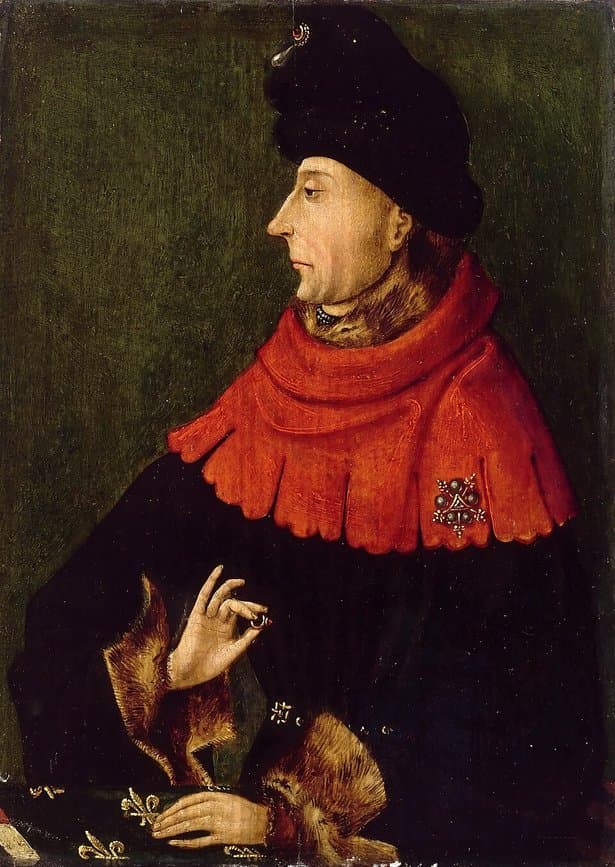
anonymous (after Jean Malouel), Public domain, via Wikimedia Commons

We have previously examined the life of Philip the Bold, Duke of Burgundy.
The second volume in Richard's Vaughan tetralogy continues with Philip's son and heir, John the Fearless (r. 1404-1419).
Today we continue.
For those who may not recall the Duchy of Burgundy was a curious patchwork of provinces spread across modern-day France, Belgium, Luxembourg, and the Netherlands. It was stitched together not so much by conquest but through inheritance and marriage alliances. Philip the Bold had stacked the deck so to speak of many of the ruling houses across the Low Countries and even down to Savoy by marrying off his children and even grandchildren into these various principalities.
John the Fearless when he inherited the vast swathes of this novel Burgundian states alongside his brothers, who fortunately remained loyal and eager allies with their small patrimonies, was well set up for success. And despite rumors to the contrary, Philip the Bold's excessive spending and generosity did not embroil his widow and sons in debt, at least from Vaughan's point of view.
While conventional historians assume John the Fearless was born into crippling debt and forced to virtually declare bankruptcy to his father's many creditors, Vaughan points out the receipts and accounts of the family and duchy do not bear this out. Instead what seems most likely is that while the remaining family was quite vocal in their letters and correspondence and external appearances to be left destitute by their seemingly profligate father, it seems that through private records and other glimpses this was merely a facade to squirrel out of as many debts as possible, true to the legacy of their father.
John the Fearless, like Philip the Bold, was a man ahead of his time in his rather intense and frequent borrowings to finance a wide variety of enterprises including enforcing reforms or military action that would expand the Burgundian tax base. Like the modern state, the Burgundians dug themselves deeply into debt with the intention that their accumulated credits and assets would quickly outpace whatever debts they could not find a way out of.
And they sure did try to escape or equivocate on whatever they could. Vaughan provides a remarkable level of detail in ennumerating the strategies and tactics John the Fearless employed to default on his debts, transmute them into something else, swap them for favors, pay for them out of withheld wages for his servants, and a remarkably savvy array of other forms of fiscal legerdemain. The Burgundians were nothing if not crafty.
Yet John certainly had his differences from his father.
Temperamentally, John the Fearless is in Vaughan's view incredibly impetuous. This can be seen not only in tactics and strategy and firsthand correspondence but even in letters, proclamations, and edicts he would send out either in his name or when he pretended to speak on behalf of the invalid King of France.
This would lead most ironically to John the Fearless forcing his servants or allies to swear oaths that within a matter of weeks he would force them to seek dispensations or exemptions from. He forced them to break the very same oaths he had coerced upon them.
The impulsive behavior led to gambles that benefitted him most in the territorial acquisitions and gains he had in the Low Countries but perhaps also undermined him in the intrigue of French politics. More on that later.
Also unlike his father, John the Fearless was very active as a military prince. Philip the Bold preferred money and diplomacy, his only so-called military venture was sponsoring the Burgundian contingent of the underwhelming Crusade of Nicopolis. This in fact was led by John the Fearless and how he earned his epithet, though a smug historian may note it was perhaps more impulsivity than courage that characterized John's behavior on that campaign as well.
Yet John the Fearless was not lazy. Vaughan provides a very convincing accounts of the extremely methodical and equally unscrupolous ways by which John the Fearless played the game of power politics. Self-aggrandizement with respect to his subordinates, the common people, neighbors, neighboring princes, etc. Everything a pawn in the game.
Depending upon one's outlook, this view can either be reinforced or countered by the plethora of reforming efforts John the Fearless sought to implement both in lands under his direct control as well as in France or over Paris in his brief stints as the foremost prince there.
Reigning between 1404 and 1419, John the Fearless established a bureaucratic department within his lands explicitly for the development of cannon and artillery which he would leverage on his military ventures, to somewhat successful effect. He was deeply, personally involved in the review of cannon design and testing as well as building his own personal arsenal of such newfound weaponry to deploy during wartime. One does not associate a military department of artillery with the very start of the fifteenth century, so this is somewhat remarkable.
But now for the French theater.
While traditional historiography regards John the Fearless as a subversive and traitorous French prince who aided the English, Vaughan's primary thesis which he extends from the first volume is that the Burgundian House were not just French dukes. They possessed a pre-eminent European state much of whose borders lay outside the Kingdom of France.
So when they extracted funds, favors, and other tools from the French royal administration, they were doing this as saavy statesmen whose primary interest was their own state which was not France. While this may be true, I do not think Vaughan's thesis necessarily cancels out the fact French officials could justifiably view such extraction as treasonous.
Vaughan's organization of his material is a bit interesting here as he starts off the early chapters by talking about John the Fearless' early reign including an in-depth exploration of his bureaucratic apparatus up to point when John the Fearless fled Paris. He then diverts the next several chapters to topical themes about John the Fearless' reign as a whole before proceeding in the concluding two chapters to return to his biography and the closing years of his life and reign.
Taken as a whole though, there are several events which punctuate John the Fearless' life when it comes to French affairs.
As a reminder, France was undergoing what may loosely be referred to as its own War of the Roses from the end of the fourteenth century into the early fifteenth century. A factor which at least was not very much emphasized in the English storytelling of the Hundred Years War in my own early education.
Philip the Bold had the personal luck to be one of the most senior members of French royal administration with no sizable factional threat and a weak French crown which he could twist and bend as he pleased, such as sending French troops to put down one of his own internal rebellions outside France while also paying himself handsomely "consultant fees" for the trouble of organizing such a gesture.
Vaughan points out that when John the Fearless came of age and inherited his holdings from his father he was quick to put his foot in the door of French royal intrigue, but a new generation had risen up who vyed for influence over a king who underwent prolonged lengths of insanity.
While the conflict is most widely known as the Armagnac vs. Burgundian series of wars, there were several stages here.
When John the Fearless first inserted himself into the royal cabinet, Duke Louis of Orleans was among the first to devise a coalition to oppose him including the Duke of Berry and Duke of Bourbon.
It would make sense for Louis of Orleans to block John the Fearless' attempts to ingratiate himself to the king. He was after all King Charles VI's brother, and seeing some Burgundian outsider have a tight grip on the throne one's brother sits in may certainly rub one the wrong way.
Louis of Orleans was not without his own complexities though. He was notably fond of women of all extractions, including his brother the king's wife. This did not make him a sympathetic character for those involved in unfolding events.
As Louis seemed to be succeeding in freezing John the Fearless out, an unexpected twist occurred.
November 23rd 1407, Louis of Orleans was riding home at night in the streets of Paris. As he proceeded, a group of men emerged out of a nearby building and proceeded to stab him to death, before dispersing into the dark.
Such a high-profile assassination was very unusual, and it was fairly clear to those at the time that John the Fearless was to blame. Equivocating a bit on this, John the Fearless fled Paris and from the safety of his domain proclaimed that he in fact did murder the king's brother but was justified because it was not regicide but tyrannicide. He concocted a full-scale scholastic defense of his position including a syllogism, citations from Scripture and the Church Fathers to advance his case.
Orleans' coalition collapsed and John the Fearless' advocates worked tirelessly in the Parisian court to promote their master's goodwill, resulting in a surprising letter of pardon for the murder of his brother. When all such affairs were laid to rest, and despite the outraged cries of the opposition, John the Fearless returned to Paris as the dominant victor.
This only lasted for a number of months though before another portentous event occurred. John the Fearless was busy working his reformer energy over Paris and put forth his propaganda machine to cast himself as a saint working tirelessly to promote the public good against the perfidies of the Orleanist party.
Such propaganda was so successful that it backfired by causing a populist uprising in Paris including a siege of the Bastille. The violence and destruction and bloodshed in the name of such reform put John the Fearless in an awkward position as he ruled over Paris but was fighting many of his accomplices who thought they were advancing John the Fearless' agenda.
The French Dauphin's quarters were invaded by the mob at one point and this seemed to have firmly entrenched him against John the Fearless permanently, even more so than would have been strategic for him.
The ambitious Count of Armagnac spearheaded this new phase of the coalition, and their efforts managed to cast the blame for the riots on John the Fearless who had to yet again fleet Paris in shame in August 1413. Primary sources were the ones to tack the name Armagnac onto this faction, misleading as it is since no royal members were referred to as Armagnacs.
For all this time both the Burgundians and the opposing coalitions had negotiated seemingly endlessly with the English, the three parties trying to play one another off of each other.
However, by the time of John the Fearless' second flight from Paris, fortune again smiled upon him as Henry V launched his momentous campaign for the reconquest of Normandy, resulting shortly thereafter in the incredibly decisive Battle of Agincourt.
While Armagnac supporters insisted that John the Fearless backed Henry V and funneled him resources, Vaughan is very staunch in noting that depsite whatever treaties or promises had been made to both sides, John the Fearless never offered and material assistance or value to Henry V in military affairs, focusing on commercial treaties.
Now he certainly did not sally forth his forces to join up with Armagnacs he was convinced sought his death or destruction, John the Fearless' younger brothers Duke Anthony of Brabant and Philip of Nevers were among the slain that day, riding essentially unaccompanied to defend France. This in its own led to political turmoil in the Low Countries whereby John the Fearless sought to assert his power so that his brothers' lands were not swept off by local claimants.
By Vaughan's telling, John the Fearless spent the years following Agincourt both aligning himself with Armagnac and French interests while at the same time working relentlessly to undermine his opposition. It is amusing to talk about this form of alignment while in alternating chapters describing the military maneouvres each side made against the other while this all unfolded.
(As one example at this point in time of how the Burgundians reimbursed themselves, Vaughan notes that John the Fearless made a marriage alliance with the daughter of King Charles VI of France which included an immense dowry, that he negotiated with himself on the king's behalf. Due to the frenetic pace of the wheel of fortune, John the Fearless seemed to have received none of this dowry so he contented himself by occupying bordering French territories in trust of that forthcoming payment. There is no record of him receiving that payment or even pressing for it. Several decades later, a treaty formalized Burgundian possession of these lands, with the treaty participants seeming to have forgotten how John the Fearless had acquired them in the first place.)
This all came to a head in January 1418 when John the Fearless launched a coup in Paris from afar which led to the murder of the Count of Armagnac, the chancellor of Paris, and other key offenders. The previous Dapuhin having died prematurely, the new younger brother Dauphin escaped. Though fourteen years old, this new Charles was so determined and energetic that he formed an opposition court, cabinet, and accounting structure at Poitiers. The former Armagnacs now became Dauphinists.
This was perhaps the most unfortunate turn of events possible for John the Fearless as the elimination of so many opponents cleared the line of succession for a Dauphin prince who would prove to be the most successful monarch France had seen in some time. Charles VII would be the one to decisively end the Hundred Years War in French victory and deprive the English of holdings they had claimed since the Norman Conquest. This was John the Fearless' new teenaged rival, one as unscruplous as he was.
Such would lead to John the Fearless' untimely death when he was assassinated on the Bridge of Montreau. By all accounts, the Dauphin had offered a ceasefire so they could negotiate setting aside differences in light of the English threat. John the Fearless went to go meet him in person where he was unceremoniously murdered, though the accounts vary how this played out.
This could have proven the complete undoing of the Valois dynasty if history had not relentlessly worked in the Dauphin's favor in the years that followed, for in so ignominiously slaughtering a leading scion, he launched a new wave of reprisals from the Burgundians.
But that will be Vaughan's third volume. John the Fearless now lay dead at forty-eight years of age.
Vaughan's historiography is a bit varied both in pace, organization, and level of detail.
He presumes the reader is well aware of the various main characters and events of the time period he is dealing with. Due to the split topical and chronological organization of the book though he may sometimes refer to events out of order in a way that is confusing, particularly if he chooses to explain them later on after referring to them multiple times as if they should already be known.
To his credit, Vaughan has clearly spent a remarkable amount of time in royal archives and his love of administrative documents really shines, if that is an appopriate way to put it, through the nearly fetishistic tabulation of accounts, receipts, payments, registers, and other numerical records of the time.
In the earlier phases of John the Fearless' life, there is exquisite attention to troop movements and which days and month were spent where with various campaigns, yet by the later stages this seems to be glided over rather hastily. Ironically the episode of John the Fearless' own death and assassination Vaughan describes as something he has to brush past without going into detail and needing to skip over most of it as outside of his concerns which is a rather strange disclaimer for a biography of a man who is perhaps most famously known for this event. Again, Vaughan will go to laborious details to outline marriage alliances, the incomes of various family members, dowry amounts and payment installations, yet feels he does not have time to talk about assassination?
(What is also strange is that he does in fact spend a couple pages reviewing evidence and making probabilistic conclusions on what transpired immediately after saying he would not provide such analysis.)
This aligns with other anomalies in how Vaughan presents his work, the excessive primary citations. While there is much to be said about seeing how these figures at the time wrote about different issues to each other, particularly the syllogism used to justify the assassination of Louis of Orleans, Vaughan has a habit of inserting the full or at least elongated segments of primary correspondence or treaties directly into the book.
This may seem an odd complaint but when such treaties and letters are translated verbatim, often occupying multiple pages, it disrupts the momentum of the narrative which will resume full pace often without summary or observation immediately after such documents are presented. The same be said of the various accounting records provided here. While it is certainly laudable for Vaughan to have manually gone through medieval archives to reconstruct such quantitative calculations (at one point he laments how this task could only be fully completed by a computer room attended to by a group of students), the amount of time he invested in such research methods metamorphize into a sunk cost that is passed onto the reader.
Vaughan at times mixes up what is narrative biography with academic research which certainly lends character to his historiography but not necessarily to its literary readability.
Despite this, Vaughan must be praised for his acute ability to read between the lines of historical evidence to extract hidden details that seem obvious when stated but were apparently overlooked by preceding historians who took the chroniclers at face value. Such work can often only be substantiated through dark nights in the archive.
One more point of critique however is Vaughan's overly deferential view of his subject matter. While Vaughan wags his finger at John the Fearless on a few occasions, although mainly in the conclusion, most of the biography is an encomium of how shrewd, clever, and artful John the Fearless was in his dealings. This is most likely as he is responding to the defining French historiography which at the time categorically viewed John the Fearless as a traitor to Frnace, but Vaughan seems a bit overly taken with the Machiavellian qualities of the House of Burgundy.
This is not to say that moralizing needs to be painted over historical storytelling, but rather to make the point that Vaughan refers to the invading King Henry V as "perfidious", "ambitious", scheming, duplicitous and as a rather negative figure. Perhaps Henry V does not need the hagiography cast upon him by most English historiography, but it is somewhat bizarre that Vaughan unreservedly admires John the Fearless for these qualities while lambasting them in Henry V. (Even in the course of narrative, Henry V emerges rather abruptly mid-paragraph as a new character the Burgundians negotiate with. No further introduction provided. his father Henry IV was alive and well in the previous paragraph too.)
I do understand the desire to defend one's subject-matter and shower them in laurels. Many historians fall prey to that trap, if trap it should be called.
But it is ironic that an English-speaking historian should inveigh against one of the most highly regarded English kings of all time in favor of a continental Duke who was not only afraid to pay for the assassination of the king's brother but after fleeing to safety advanced a syllogism to justify such action.
The book is not an unending paean as I have mentioned already. In fact, Vaughan points out the irony that one so named "the Fearless" spent most of his life in hiding whether in Paris or in Burgundy, paying for an extensive bodyguard and armed retinue to protect himself from the treachery and assassins he had set upon Louis of Orleans. And in spite or because of all that paranoia, his death would be one of assassination.
He lived in service of his family, and yet in increasing the standing of the Duchy of Burgundy, it came at a cost of life, and perhaps soul.