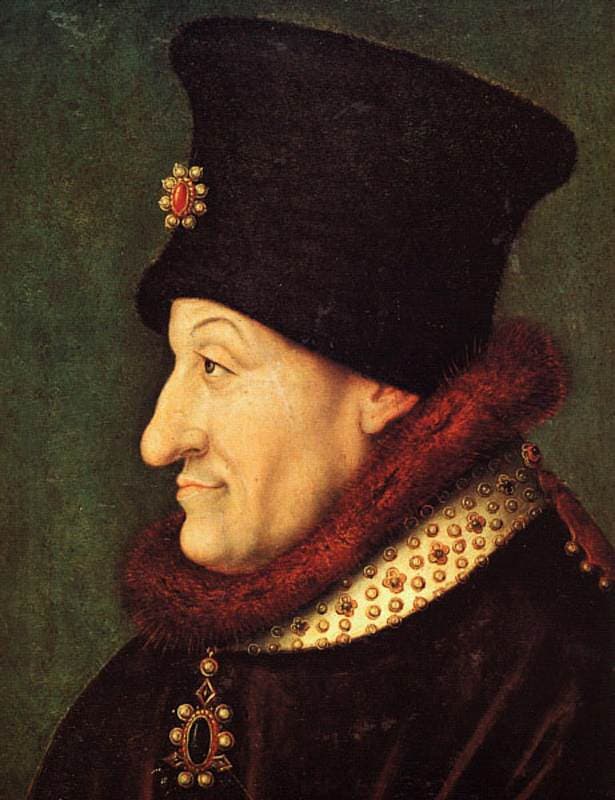
anonymous, Public domain, via Wikimedia Commons

To be a medieval ruler, recognition is generally reserved for those of martial ability or accomplishment.
If we look at the English as an example, Who cares for the religious or intellectual patronage of Henry III or Henry VI in light of their military failings? Richard I is renowed as the warrior king who stood toe-to-toe with Saladin even while he depleted the royal treasury and left little material behind from his father's vast reserves. Poor King John was stuck with the bill.
Military renown is enough to overlook quite a many sins. But those without such conquests to their name have a much harder time edging their names up the rankings of prominence in the ledgers of history.
Philip II, the Bold, is one such exception. These are some notes from my recent reading of Richard Vaughan's Philip the Bold: Formation of the Burgundian State (1962).
Who was Philip the Bold (1342-1404)? Son of King John II of France, Philip is one of the most noteworthy political actors of the medieval period to operate like a king though he never bore such a title.
Let us first consider the epithet.
"The Bold" would indicate a man of strategic daring and fortitude. Perhaps some tactical stalwartness earned him this epithet, like "Stonewall" which emerged from First Bull Run.
However, Philip inherited this distinction through what is more sheer luck than anything.
Born during the onslaught of English invasion during The Hundred Years War, Philip joined his father the French king at the age of 14 in the famous Battle of Poitiers.
What makes this battle more decisive than English victories at Crecy or Agincourt is that the English not only crush the French in this engagement but they also capture not only King John II but his son Philip as well.
Philip spent several years as a royal captive (which was more like a vacation than anything) in English palatial estates.
Eventually a hefty ransom was assembled to pay for the king and his son's return alongside the concessions of the Treaty of Bretigny in 1360.
It is through virtue of Philip's participation in this unusual political episode that his father deemed him worthy of the title "The Bold" and in addition granted him the Duchy of Burgundy in 1363.
Already at twenty-one, Philip the Bold was endowed with the primary title which would mark his rule. Never as a king, for the crown of France would pass to his brother Charles V, but as a ruling Duke both in his own realm and in French royal affairs.
Philip II had divided yet simultaneously overlapping interests.
On the one hand he was a subject of France, and he would wield great influence in the French royal court as the crown passed from his father to his brother and then to his nephew, all in his lifetime. On the other, he ruled with near complete autonomy his own set of lands that were not entirely subject to the French crown.
Philip II's Duchy of Burgundy would only grow through his vigorous efforts, not through conquest, but through ruthless politicking and diplomacy.
Conquest was not Philip the Bold's forte. The only major military venture he oversaw that actually occurred, the Crusade of Nicopolis, was an embarrassing failure.
An assembled naval invasion of England that he sponsored, planned, and organized failed to be carried out, due to what seems to have been a combination of bad weather and royal cold feet. Nonetheless, such an expedition was considered a remarkable achievement for the force of arms that it mobilized.
This was not the ingredient of Philip II's success. Rather he inverted Clausewitz's famous cliche through carrying out politics as war by other means.
Through his own marriage he garnered the prosperous provinces of Flanders, Brabant, Artois, and County of Burgundy (not to be confused with the Duchy of Burgundy).
With each child he had, Philip II quickly arranged strategic and diplomatic marriages for each and everyone one of them. As dowry he promised vast sums of money, little of which he actually provided, even when hard-pressed.
And this is the key to Philip the Bold's legacy: his ostenantious and manipulative leveraging of his wealth.
Every expedition, every mediation, every diplomatic gathering, wedding, etc. that Philip the Bold sponsored, he made sure was extraordinarily excessive in budget and that everyone could very well see how much money and luxury surrounded Philip II's entourage.
One such use of this display is that minor nobility in his sphere would seek to attach themselves to him and the Duchy of Burgundy, for example through a dynastic marriage.
Philip II of course promised a hefty dowry or stipend but in return requested a cut of their province's revenue. He rarely honored his end of the deal but made very well sure that the new in-laws would honor theirs. Especially since he wielded significant force-of-arms not only in his own right but as brother and then uncle to the King of France.
This proto-Ponzi scheme was one tactic for his steady amassment of wealth, but Philip II had other ways as well.
Already by this point in history, the French royal treasury was one of the wealthiest centers of assets and ongoing revenue in all Western Europe.
And Philip II had no reservations at putting such resources to his personal use even as the French ship of state was in dire straits at this phase of the Hundred Years War.
One of the joys of Vaughan's biography (and also what makes it very dry) is his thorough perusal of receipts, treasury sums, and payments in statements of record between Philip's desmene and Paris.
Vaughan points out many instances where Philip would provide services for the French crown such as organizing the English invasion, engaging in mediation, or even simply pressuring someone into compliance, and then acting also as the controller of French treasury would pay himself ludicrously handsome sums as compensation for his services.
At the same time, when Philip was dealing with uprising or unrest in his own lands (outside France), he would leverage his influence in the French court to send French armed forces to deal with the problem in his own lands. He would then reimburse himself out of French treasury for his trouble, even though such trouble was purely internal to his own non-French territory.
To solve your own personal problems using somone else's resources is one thing, but to then pay yourself for your services in solving this problem is quite an amusing feat of accounting, reminding us of our own federal government in our time.
So through his own wealthy lands, his expropriation of neighbors and allies' assets, and rewarding himself from the French treasury, Philip II was able to assemble one of the wealthiest and most luxurious courts of late medieval Europe.
Ironically it is these elements of a taste for opulence and a mastery of diplomacy that would characterize much of French national character for the centuries to come. Here it found a masterful practitioner in a son of French royalty who made his own way in his neighboring lands.
The book covers other topics of relative interest (or non-interest) in Philip II's court, particularly the administration and organization of his court's finances across each of his various provinces. How English diplomatic efforts unfolded in the truce of these decades, or how the Great Western Schism became another political lever at Philip II's disposal.s
But what is most remarkable through what could very easily be labeled sleazy activity, he earns a seat himself as one of the foremost statesmen of all Europe, minting his own wealthy, powerful European state the Duchy of Burgundy out of a patchwork of wealthy provinces. That his son John the Fearless could launch a devastating civil war for the French thrones against the Armagnacs is only possible because of the unremitting efforts of his father to accrue and accumulate, beyond what anyone could expect was reasonable.
Of course Philip the Bold was incredibly lucky to be born as he was in such a time. He was only able to exploit the French state so thoroughly because of not only the divisions and internal turmoil among its own nobility, but because his brother died relatively young, leaving the throne to an 11 year old Charles VI who would suffer from insanity most of his life. It was under Charles VI after all that Henry V would not only invade France but have his own son crowned under the French throne. One can only speculate how much of Henry V's achievements are due to the parasitical bloodletting of Philip II.
Philip II could very easily have dedicated his entire attention to restoring and strengthening the French state. But that was not his goal. Instead, he took every opportunity at his disposal to expropriate and dismantle French state to aggrandize his own personal interests.
Is he admirable for that? That is for you to judge.
If anything though, Philip the Bold is perhaps the greatest success story of the adage, "God helps those who help themselves."