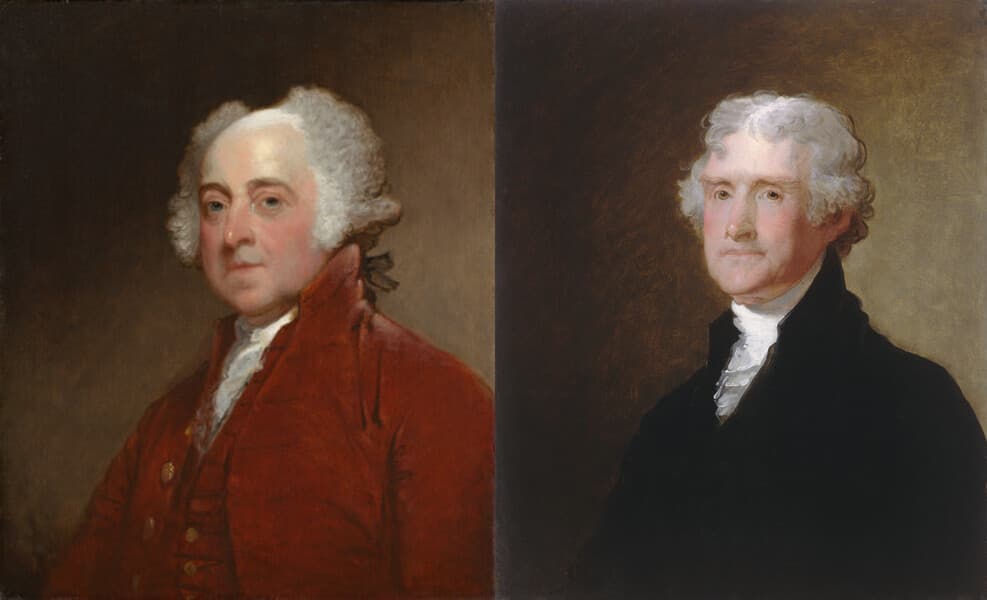
Gilbert Stuart, Public domain, via National Gallery of Art (John Adams, left) and National Gallery of Art (Thomas Jefferson, right), c. 1821.
Today I wanted to write something timely on this momentous date: July 4th, 2026.
This day marks the 200th anniversary of the deaths of John Adams and Thomas Jefferson, who both passed away on July 4th, 1826, fifty years after the adoption of the Declaration of Independence.
To complete a patriotic study of sorts, I decided to read through the correspondence of these two towering figures, erstwhile friends and rivals.
While history classrooms are quick to note the fraught rivalry between these two men, climaxing in the Election of 1800 where John Adams was obligated to concede a second presidential term in favor of a vocally critical rival, it is not so often highlighted how deep their friendship had been before and after.
Their correspondence spans nearly fifty years from the spring following '76 to the year of their mutual death. I read the edition compiled by Lester Cappon whose editorial notes paint an illuminating picture of events surrounding each note.
As the Revolution solidified the foundations of independence, Adams and Jefferson both took up the highest possible diplomatic roles for their fledgling nation as Adams played the ambassador to Great Britain while Jefferson the ambassador to France, as Benjamin Franklin took his leave and entered retirement.
After a near complete epistolary silence that lasted from 1796 until 1812, Jefferson and Adams would warm back up to each other in those long-winded meditations that elder statesmen should be entitled to after decades of public service, watching the affairs of the world from their private domiciles, content to hand on the torch to the next generation.
Jefferson would die the morning of July 4th in his Virginia estate of Monticello at the age of eighty-three.
Hours later the widower John Adams would pass away peacefully in his home up in Massachusetts at the age of ninety, his last words: "Thomas Jefferson survives," not knowing that his last living friend of his generation had passed earlier that same day.
Adams and Jefferson represent two species of American whose sentiments, habits, temperaments, and ways of life weave their way through American history as friends or rivals, depending upon the era.
New England and the Old Dominion of Virginia.
One can find colorful portraits of both kinds in Albion's Seed, but here we look at two of their key figures.
John Adams was born in 1735 in Braintree, Massachusetts. His great-great grandfather Henry Adams emigrated from Barton St David, Somerset, in England and arrived in the Massachusetts Bay in 1638.
Adams' father was a farmer and cobbler. At six, the boy John would commence his schooling and enter Harvard College at age sixteen, already equipped in the Greek and Latin that would guide his studies into law. He was admitted to the bar in 1759 at the age of twenty-four.
Adams rose to prominence first in his vocal and vociferous opposition to the Stamp Act of 1765 and gained local notoriety in providing a legal defense to the British soldiers who fired on protesters during the Boston Massacre, leading to the controversial acquittal of their captain.
While conservative and an Anglophile compared to other Founding Fathers, John Adams was ardently outspoken toward the overreach of the British government, particularly when the crown usurped control of paying the judiciary's wages from the colonial government.
Representing New England in the First and Second Continental Congress, he was a key orchestrator of the "Committee of Five" who would lead the drafting of the Declaration of Independence. Ironically, though Jefferson thought Adams should write the Declaration of Independence, Adams successfully lobbied for Jefferson to draft it.
Thomas Jefferson was born in 1743 into the Virginia plantation gentry who safeguarded the governance of the state from its colonial days until the Civil War. Like Adams, Jefferson studied the classics in his youth and entered the College of William and Mary at the age of seventeen. From there he would also commence a career in law, gaining admittance to the Virginia bar in 1767 at the same age as Adams.
Within two years, Jefferson would represent Albemarle County in colonial Virginia's House of Burgesses where he would adamantly pronounce a need to boycott all British goods until self-governance could be guaranteed.
Jefferson was among the youngest delegates of that Second Continental Congress--where he would first meet John Adams--writing that famous document the Declaration of Independence at thirty-three years of age.
So we arrive at the first handful of letters exchanged between the two. Four letters in 1777 reflecting their camaraderie as outspoken, decisive advocates for independence against moderates and loyalists.
Both recognized the fragility of the current loose affiliation of states which must strive earnestly toward unity lest they should be separated and perish in isolation. As Adams put it, "The great work of Confederation, draggs heavily on, but I dont despair of it. The great and Small States must be brought as near together as possible."
Aside from a letter from Adams in Paris in 1780, an ellipsis occurs until 1784 after peace with Britain had been signed in the Treaty of Paris.
The correspondence resumes in a new chapter, the first chapter of American independence under the Articles of Confederation. While Jefferson was appointed Minister to France Adams received the office of the Ambassador to Great Britain, both reflecting their own nationalistic preferences which would later shape their rivalry during their respective presidencies.
Their letters reflect how truly scrappy the United States was in its earliest days.
Congress lay months away for a single message and even then its deliberations were slow and its authorization inexact. Deeply unhelpful factors for two statesmen who between the two of them had new trials day-by-day as various European ministers sought to maneuver them for their own respective interests.
Operating in Paris where Franklin would shortly depart, the inexperienced Jefferson was forced to contend with negotiating trade deals with all the various European states whose ministers were in Paris, such as with Prussia, Italian states, Portugal, or even the Teutonic Order.
More than this though, Jefferson had the limited set of United States treasury funds at his disposal to pay out national obligations, such as the wartime debt to various nations and stakeholders including French and Dutch parties who clamored for immediate payment of overdue obligations.
Of course as with all American debt, there was more debt than cash on hand, so Jefferson wrote frequently to Adams requesting his judgment on how to pick and choose between the competing and ferocious barks of various creditors.
He was forced to turn away the French officers who assisted in the Revolutionary War and whose promised wages were not forthcoming (and which would endure as a diplomatic scandal into Washington's presidency).
For those familiar with the trivia of early American history, there are of course the Barbary Wars (1801-1815), the first military engagements the United States fought as a nation against the pirate states of North Africa.
The seeds of this conflict can already be seen in the 1780s as Jefferson is trying to ascertain from Franklin and French courtiers how exactly one goes about making a "peace deal" with these Barbary princes.
A topic that continues to surface across months and years as it slowly dawns upon Jefferson that European states simply offer up bribes and other payments as protection money to keep the pirates at bay. When Jefferson would become president decades later, he would order the navy to attack these pirates directly.
Politics and diplomacy were only part of the material of their correspondence which swelled with personal matters as well.
Among these are the transactional and logistical requests of expats abroad. Adams having Jefferson buy a large order of French wine in Paris to send to London, while Jefferson having Abigail Adams visit the various shops of London for the best lace tablecloth.
Their letters include very exact quantities, measurements, and prices of receipts and debts owed back and forth, always expressed in the most congenial and undemanding terms.
One very amusing example is a frustrated Adams who apparently had purchased a one year magazine subscription while on the Continent but finding this subscription and its bills had somehow followed him years later to London with repeated demands he pay the French gentleman who organized the periodical.
Quite a bit of space is given to Adams sending money for multiple years of a subscription he had never agreed to, for Jefferson to pay the French periodical on condition he would never see or hear about this magazine ever again.
A very relatable situation.
Many letters, even in their final years, are letters of recommendation and introduction for younger men passing through who hoped to gain entry to meet the other towering figure. (Amusingly, Adams will write these recommendations far more often to Jefferson. So much so that he will often comment on how embarrassed he feels that Jefferson does not send young people to him and that he is worried Jefferson resents him for not filtering out so many ardent admirers.)
More touching is another case when Jefferson sent for his youngest daughter Polly in 1787 to travel all the way from Monticello to join him in Paris, traversing the Atlantic Ocean with one of his slaves Sally Hemings.
The pair arrived first in London where the frightened Polly was taken under Abigail Adams' wing to recuperate before making the final journey from London to Paris.
Abigail Adams fell in love with this new daughter whom she looked after with apparent deep care. When a French gentleman who did not speak English arrived to take Polly to her father, Polly fell into tears and shrieks, protesting she had never met her father (Jefferson had been gone for quite some time now.)
Abigail relayed all this to Jefferson but would finally convince Polly to take up the journey and that they would see each other again in the future.
In fact during the silent period of resentment between the Adams and Jefferson clan that would claim the 1790s and early 1800s, one of the only breaks in the silence is a letter of condolence from Abigail Adams to President Thomas Jefferson in 1804.
For in 1804 this sweet little girl that Abigail had cherished would die at the age of twenty-five in childbirth. Memories from fifteen years before in London would grieve Abigail at such news.
Both Jefferson and Adams remained in Europe at their posts during the Constitutional Convention of 1787, listening for news with a mix of anxiety and consternation.
While this was underway, Adams penned a three volume magnum opus A Defence of the Constitutions of Government of the United States of America, his own theory of government.
Such a book was not so much written to try to influence the Constitutional Convention but rather to defend America against the smug criticisms and jabs of various European intellectuals such as Turgot who laughed at the idea of bicameralism that was the center of the early American experiment.
Whether or not such a work had an impact on the Constitution itself, incidentally many of Adams' ideas would be reflected in what would come to form the American government.
Jefferson who received his own copy to read remarked in an amicable way that he felt Adams was too monarchical in his sentiments, whereas Adams protested he was more afraid of aristocracy than monarchy.
Sentiments that would divide them the rest of their careers and lives.
Jefferson for his part would watch the unfolding of the French Revolution from the heart of Paris with great anticipation and admiration, writing to Adams of the excitement of what he saw unfolding, the effects of the American revolution now in the capital of all Europe.
Both were recalled from their posts by the end of the 1780s, and both received hearty homecomings when they disembarked on the western end of the Atlantic.
But their retirement was short-lived for both would be appointed to the highest level of Washington's presidential government, Adams as Vice President and Jefferson as Secretary of State.
Their correspondence grows sparse yet again, this time because now they were for the first time working alongside each other as part of the administration.
One can only speculate on the nature of their conversations during this period as tensions mounted, tempers frayed, and Adams' characteristic candour cost him friends and allies.
Both from correspondence before and after it is interesting to note the passing allusions to the news items of the day.
It is easy to think that the events we consider historically significant enough to cast into the ledger of schoolbooks were in fact widely commented upon with the same names we call them today. The XYZ Affair, Shays' Rebellion, the Quasi-War.
Those brief blips in American history that pass in and out of the spotlight of the news, magnetically drawing so much animus and pontification before passing into the palimpsest of historical record, ever etched over by something more new and more controversial.
We see the faintest premonition of the silence to follow in the shortest of notes from Adams to Jefferson in 1794 noting the travails of the "Din of Politicks", as their correspondence slipped into intermittent conversation over a history of the French Revolution borrowed between the two men.
And then in the last epistle before the curtain falls, Jefferson writes to Adams from Monticello on December 28th, 1796.
This is the election in which Adams defeated Jefferson, despite Hamilton's last-minute attempt to switch sides and undermine Adams by hustling electoral votes.
This election and the election to follow would set unholy precedents in the mudslinging of US presidential elections, now that the fatherly George Washington had exited the political scene.
Jefferson writes:
"The public and the public papers have been much occupied lately in placing us in a point of opposition to each other. I trust with confidence that less of it has been felt by ourselves personally. In the retired canton where I am, I learn little of what is passing: pamphlets I see never; papers but a few; and the fewer the happier."
The letter goes on to offer Adams sincere congratulations that even though their opinions may differ he still trusts in the character of his rival and wishes the best fortunes for the Adams presidency.
The editor notes that this heartfelt letter was sent to Madison with a note from Jefferson asking Madison to determine whether or not it would be appropriate to send such on to the newly elected president.
Madison, it seems, decided it was not wise to pass on such a congratulatory note and held onto it until the archivists claimed it long after the passing of both Adams and Jefferson.
Who knows what may have changed if such a sympathetic letter from one rival to another were delivered, but this marked the end of a friendship.
In the intervening years we have two sets of letters in the frozen silence of resentment.
The first dated February, 1801 shortly after Adams was defeated by Jefferson in the subsequent election was no note of congratulations or thanks but a terse memo that Adams would leave the horses and carriages in the stables for Jefferson's use as the "President's Household".
Shortly after Jefferson provides a brief note of mail to Adams left behind in Washington that he seeks to pass along. In response, Adams notes that Jefferson must have missed the news that Charles Adams had died and he was now in mourning. Despite such an oversight, John Adams wished, "a quiet and prosperous Administration" to Jefferson.
The next set of letters in 1804 are between Jefferson and Abigail Adams. Abigail, who wished to offer Jefferson her deepest condolences, reached out with ambivalent care. She broached the subject of past grievances with an initial delicacy, but the back-and-forth between the pair eroded into airing of wounds not quite healed.
The correspondence was broken off between Jefferson and Adams' wife though John Adams was to have the last word, writing at the bottom of his wife's last letter, "The whole of this Correspondence was begun and conducted without my Knowledge or Suspicion [...] I have no remarks to make upon it at this time and in this place."
One cannot help but feel here as in other choice moments in Adams' letters that Paul Giamatti was an inspired casting choice for the HBO mini-series. His personality drips through the civility that laces his correspondence.
Darkness would fall upon these two former friends.
Cappon notes there were in fact several attempts at rapprochement between the two starting after Jefferson left office. Mutual friends who felt this estrangement ought to be undone now that both men were retired from the public sphere sought to gently massage each other toward reconciling.
Dr. Benjamin Rush who was a mutual friend and a signer of the Declaration of Independence was the one to finally facilitate this.
Rush told Adams in October 1809 that he had a dream where he was sitting reading a book about the history of the United States and that in that book it said that in November 1809 Adams and Jefferson became friends again.
Adams apparently chuckled at this, seeing the ruse, and saying "it is not History. It may be Prophecy." Though he did nothing further.
Rush relayed any positive words one man had to say about the other in his visits between the two.
Adams at one point called Rush out again for the likelihood of applying equal manipulations to Jefferson to initiate a detente.
Eventually this trick worked.
In January 1812, Adams sent Jefferson a copy of his son John Quincy Adams' two volume work on rhetoric and oratory with the semi-facetious introduction "As you are a Friend to American Manufactures under proper restrictions [...] I take the Liberty of Sending you by the Post a Packett containing two Pieces of Homespun."
Within the month, Jefferson would respond playing along with the metaphor before turning to "recollections dear to my mind" and expressing his gratitude to be finally out of politics and left to study his classics and enjoy his time. Providing some details of his daily routine he in turn asks Adams for the pleasure of describing how he likes to spend his retirement.
With that a fresh effusion of warm letters running for pages on pages from each participant runs through the following years. Over half of their entire correspondence comes from the last fourteen years of their lives.
As retired statesmen, both reflect on a vast range of topics including family events, recent readings, philosophical speculations, and commentary of events abroad.
It is curious that neither really comment at length on events in America throughout these decades instead focusing upon European affairs, most especially the apex and fall of Napoleon and reflections on Napoleon's legacy.
It is not clear if that is because like Europeans today who talk about American news more than their own as it is more world-changing or because they wished to avoid the embers of past feuds.
The commentary remains all the same fascinating as these two vestiges of the eighteenth-century Enlightenment, writing in the nineteenth and still given to the older abuse of capitalization, wrestle with the advances of the eighteenth century and their legacy, though both are quite content to pass the torch now that they are in retirement.
If there is one subject which occupies more than any other in these letters, it is that of "Religion".
Both are deeply fascinated by this subject, in particular by the work of Joseph Priestley an English polymath who was an early proponent of "rational Christianity" and early developer of modern biblical criticism.
Priestley was a landmark figure in the development of Anglophone liberal Christianity with the exploration of heterodox opinions that fit better with the foundations of Enlightenment thought and reason.
Adams and Jefferson who both assured each other they were in fact Christians though not without severe doubts on the authenticity of Scripture and the divinity of Christ were enamored with this new movement.
Both mocked the very idea that anyone could take the doctrine of Trinity seriously.
Unitarianism was on the rise and would soon come to dominate New England.
They explore many of these conventional questions around orthodox Christianity, and though neither offer anything particularly novel or insightful in those conversations per se, it is interesting to see how they are aligned with particular cultural tides and the effects it has on other beliefs and convictions they hold.
This leads to apparently peculiar statements such as in a letter from Adams to Jefferson on November 4th, 1816 where he recounts the news of a new "National Bible Society" in America, lamenting the proliferation of Bibles here and abroad.
"Would it not be better, to apply these pious Subscriptions, to purify Christendom from the Corruptions of Christianity; than to propagate those Corruptions in Europe, Asia, Africa and America!"
To be fair Adams does go on to say he remains a true Christian but wishes to purge it of mysticism and error before those falsehoods are introduced to other societies.
A sentiment Jefferson heartily agrees with.
Yet even among these comments both men are staunch Protestants and proudly so. It often seems they are more proud of their Protestantism than of their Christianity at points.
This comes out ever so clearly in their virulent anti-Catholicism.
Jefferson expresses the utmost frustration that he has to hold onto the principle of religious toleration that he advocated so much because it has led to the entry of Jesuit orders to America, and how much he wished there was some political expedient to flush them out and prevent their corruption.
Whatever their derisive remarks are against Luther, Calvin, and other more traditional theologians and errors, they are true heirs of the Reformation in their utter hatred for Catholic "papistry".
Like many other Enlightenment figures, both Jefferson and Adams view the papacy as the quintessential death grip of the medieval age, holding the world back from progress, reason, nationalism, and self-government.
These comments surface so frequently, that although Jefferson initially voiced an optimistic salvo of the upcoming giant of the south as the Latin American overthrow of Spain's rule unfurled, both end up agreeing throughout the 1810s and 1820s that such Latin American revolutions were in fact disastrous.
This is because those colonies were infested with Catholicism so there would be no way for them to be able to rule themselves properly as their people were ruled by mysticism rather than educated by reason.
It would have been better if they had remained under Spain longer until institutions of education could have rusted the shackles of medieval Christendom and those peoples could then with full preparation break forth from the colonial chrysalis.
But alas every people has a right to seek their own self-government, so it is best not to stop them even if they are not ready. Both are pessimistic of how the Latin American peoples would splinter and fall prey to dictatorships and foreign influence.
This distrust of ecclesiastical institutions and popular faith in large part impels both men, and Jefferson in particular, to venerate education as the premier advance they wished to see progress in the nineteenth century.
Again this is characteristic of Enlightenment thought.
If the trappings of the church are to be abolished or at least greatly diluted, then modern schools, university, and education must step to fill the pedagogical void left in the dying church's wake.
This in fact was the final public achievement of Jefferson's career, dotting these letters of the 1820s. Frustrated at the inertia and reactionary posture of his alma mater, the College of William and Mary, Jefferson poured forth his efforts into organizing and founding what would come to be the University of Virginia.
His time, money, land, energy, and connections would be exercised to an extreme to found a thoroughly modern university in the center of the Old Dominion.
Jefferson made sure that there be no theology or divinity program stunting the intellectual spirit of his new university. Nor would metaphysics. Philosophy must be modern. And so too must other modern disciplines be given room.
Key to Jefferson's political philosophy was the idea of rule by natural aristocracy (as opposed to the artificial aristocracy of moneyed interests).
The formation of such a natural aristocracy would of course center upon this new university.
To Adams' mild frustration, Jefferson would prognosticate the beauty of washing away old books and pages and that the spirit of education and modern sciences may soon render the older books obsolete.
There is a double irony here, as Jefferson clearly holds Greek and Latin classics in high esteem. Adams and Jefferson incessantly quote obscure classical poetry to each other in Greek and Latin, sometimes even comparing their French, English, and even Italian translations.
But for Jefferson, the classic would not hold the uniquely privileged place in his modern education programme that it would in the humanist programmes (themselves born out of pedagogical reform of the sixteenth century).
Such antique subjects, he thought, must remain subsidiary to what is modern and forward-looking.
This remains one point of contention between Adams and Jefferson in recalling an old disagreement, for Adams maintains that all truths are timeless and can be found in the earliest as well as the latest authors. Jefferson by contrast, believing in the progressive development of truth, sees no use in holding on to such trinkets out of nostalgia.
Yet in the victory of modern pedagogical philosophy, one must wonder if Jefferson would still hold the same views. The civic virtues and values he so highly cherished and inherited from his humanist education and readings of the classics, the ways in which every letter was signed "Your most humble and obedient servant" between the two, the idea that one would retire to their farm after a career in dirty politics, is a far cry from the rise of the professional class.
If Jefferson were to see snapshots of the civil service of the twenty-first century, or of FDR's administration, or even of Lincoln, he would be repulsed by the lack of common ground these "modern" men would share with him as one steeped in agriculture and classics.
The second irony of course is that the university which Jefferson nearly single-handedly brought into being would so repudiate its founder over his slave-holdings, racism, and infamous relationship with Sally Hemings (the same who brought his daughter Polly to Paris and would bear his child during this sojourn in France).
It is truly in the Jeffersonian spirit in washing away the errors and embarrassing beliefs of the past, that the University of Virginia would take the steps it has in recent years to distance itself from its founder.
Even in the last years of his life Jefferson would with relish pronounce in one letter how blood must be spilled and in great quantities for progress to be accomplished. It is unfortunate but it will inevitably be worth the cost.
These remarks, coming after decades of French Revolution, Napoleon Bonaparte, and the political instability of the French Restoration, certainly perked an eyebrow raise from Adams who resolutely condemned the violence of democracy and its masses, evil appetites that must be kept in check.
Again we see here the liberal and conservative spirits intertwined in their dance, one that would emerge again in the liberal support of other left-leaning terror regimes like the Soviet episode.
A duel of viewpoints we witness in the United States to this day.
But again not all is politics or philosophy in these reams of correspondence.
Much time is spent summarizing or expositing various books each is reading.
Jefferson at various points remarks with surprising acuity on natural history, astronomy, mathematics, and other fields.
Both men are clearly widely read across many subjects and their intellectual range is delightful to accompany even if at times it smacks a bit too much of the performative dilettante.
At times new gossip or private correspondence would surface in the newspapers of those dark years in which the two men had uttered rather caustic remarks about the other, yet in all cases both of these retired politicians reiterate their foremost commitment is their friendship and not to allow any such disputes of the bygone past extinguish the intellectual companionship the two shared from their remote homes.
At times there are the typical elderly moments where Jefferson or Adams would ask one another, "how did that happen again" particularly around the events of the Revolution, their diplomatic engagements, or beyond.
Some such questions ironically can be found by flipping to the earlier years of their correspondence.
At one point North Carolina surfaces at a flash point, causing Jefferson some indignation. One newspaper argues that the Mecklenburg Declaration of 1775 predates the 1776 Declaration of Independence and should be held as the true founding document when Charlotte, North Carolina broke away from Great Britain.
Jefferson clearly fell for the clickbait in his exasperated letters to Adams asking for assistance in repudiating such claims that may displace his legacy as the author of the Declaration of Independence, going so far as to attempt to argue it being a forged document.
Both men eagerly read the pulpy histories of the United States that cropped up in these first few decades of the republic, both lamenting how fictitious or inventive such accounts were.
Adams for his part categorizes histories as either "adulatory panegyrics" or derisive hit jobs, going on to lament how unfortunate it is that so many meetings were held in secret without any minutes or notes, of which most participants were long deceased.
Rational men of the Enlightenment cringing at the image of the Founding Fathers transmogrifying into some kind of medieval Arthurian legend without any grounding in reason or historical factuality.
Another amusing moment comes in the early years of their reopened correspondence where Adams volleys a not so subtle "I told you so" to Jefferson when the United States navy won unexpected victories against Great Britain in the War of 1812.
John Adams was one of the largest advocates of a federal American navy early on, much to Jefferson's resistance to the militaristic and imperial temptations such a force could bring.
Another irony lies here in the fact that one of Jefferson's first diplomatic acts as president was to send the newly founded navy to attack the Barbary States and win a victory that would lead to the collapse of these pirate states in the Mediterranean.
We do not know if Jefferson bristled at this remark but he tips his hat to John Adams in reply, naming him the Themistocles of America who foresaw the power of "wooden walls", one of their beloved classical allusions.
But again, both men frequently voiced their pleasure at being left out of politics (for the most part) following their retirements, voicing nothing but disdain around the partisans who poisoned their respect and admiration for one another.
The editor leaves in one curious anecdote about such apathy.
When the United States defeated Great Britain in a land engagement at the Battle of New Orleans in one of the greatest symbolic victories of American military history (another historical thread I have written about here), Jefferson's grandson rushed to Monticello to bring the president emeritus the news.
Jefferson was so nonplussed that he begged his grandson to leave the news for the morning because he just wanted to get to bed.
Their names were unfortunately dragged back in during the Election of 1824 when John Quincy Adams stood for the presidency in that anomalous four-way contest, but their friendship remained unblemished. Adams would bemoan politics on several occasions in these last two years of their lives, as both would pass away before Jacksonian politics would emerge and cast John Quincy Adams into ignominy.
These were two men who were content with what they had accomplished and knew that the legacy of the governmental system they brought into being was now in the hands of a new generation.
It is easy for us to treat the Founding Fathers with the "adulatory panegyric" which casts them in the intransigent stoicism of honorary sculpture, but these were human men with strengths, flaws, faults, feelings, and ardent conviction.
We should most certainly admire the generations that have come before, learning perhaps the contradictory truths they bequeath us, and in so doing strive to become a truly new generation that carries on the legacy given to us, and seeing what we can do to strive even higher than those who came before.
The incessant "din of politicks" perpetually seeks to demoralize and discredit any sense of growth or achievement then as it does now.
It is up to us as it was to them to brace ourselves against such cynicism and negativity that lulls us into the inertia of resentment and strive to reach new heights in faithfulness to the spirit of our forefathers.
That is how they treated the present in looking to the future.
What is to stop us from doing likewise?