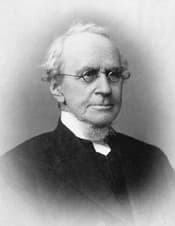
John Williamson Nevin. Contemporary photograph, Public domain, via Wikimedia Commons
I have written here before on obscure figures whose thought lies sifted out by the sands of time.
Names that may be dropped from the classroom and thence from memory a generation or two within their passing.
John Williamson Nevin is one such figure.
I recently indulged in D.G. Hart's biography John Williamson Nevin: High Church Calvinist, picking up his name from Hart's own history of American Presbyterianism.
For us today Nevin is a peculiar figure not merely as a significant church administrator but as a defender of old high church Protestantism against Second Great Awakening innovations that are commonplace among evangelicals today.
Nevin was highly resistant to the sentimental nature of this new piety which he believed was a betrayal of the original Reformers vision.
But Nevin also was not a strict conservative.
Influenced by German Idealism, Nevin would work to incorporate that philosophical tradition within new theological articulations, particularly around sacramentology.
Notes on a Life
Nevin was a singular force in his time for his community.
Though born into Scotch-Irish Presbyterianism as the United States entered the nineteenth century, and a graduate of Old Princeton under the tutelage of Charles Hodge, Nevin was called to minister to the fledgling German Reformed Church.
He would found, define, and be or more the sole face of the so-called Mercersburg Theology with Philip Schaff as his accomplice. (Schaff would later move on to become leading editor for the English-language edition of the Church Fathers series which is still in wide use today.)
Nevin would not only be president of the seminary of Mercersburg but would more-or-less administer the Pennsylvania Dutch denomination, while also writing prolifically in theology journals, despite his ailing health and also very public doubts about whether he should convert to Catholicism.
Some other fun trivia is that James Buchanan would move in near Nevin and experience a return to faith through Nevin. Additionally, Nevin's daughter would marry into future president Woodrow Wilson's family as well.
The German Reformed Church was a idiosyncratic institution in America.
Its community were the forgotten German Calvinists who settled in Pennsylvania. Many of these were displaced from the Palatinate in the Nine Years War.
They lacked strong ecclesiastical structure or union, only bound together through cultural and community identity.
Hart's thesis is that the life of the German Reformed Church as a denomination was really bound up in the singular personality of Nevin.
Despite several intradenominational conflicts with certain pastors, the unyielding Nevin would more or less win every dispute within the denomination such as with Joseph F. Berg.
Even in circumstances in which Nevin seemed to be overplaying his hands, the Synod generally voted in his favor and his embittered antagonists would transfer to some other denomination.
This is all the more curious given that Nevin was developing his own personal theological viewpoints and would often deploy these directly into the German Reformed Church, exercising his denominational influence.
Given his views changed repeatedly and he rather candidly admitted his temptation to join Roman Catholicism, it is surprising he was given such leeway.
One cannot help but notice in Hart's biography how muted and small in scale Nevin's life is, especially when compared to more towering figures such as Finney and Hodge in the life of nineteenth century American Protestantism.
He lives and works exclusively in a few Pennsylvanian counties, he writes in a few regional journals. He writes only two formal books, and even those are relatively short.
The number of names that rotate through his life are fewer than one often encounters through larger men of the world across biography.
There is a charm in this though, and it should not discount the value of Nevin's insights as a snapshot of a thinker who stood against the near-universal tide of the Second Great Awakening.
Second Great Awakening
For a brief historical recap, the United States underwent a large scale religious revival for several decades as the nineteenth century opened. It would also prove to be arguably the last nationwide religious revival in the Western world to this day.
Some historians point to Cane Ridge, Kentucky 1801 as the inaugural salvo of this new movement.
While Protestant worship historically was reserved to subdued, laconic (and some would argue lethargic) forms of worship such as singing from the Psalter or reciting the liturgy, the Second Great Awakening injected some spunk into worship services.
Cane Ridge for example saw preachers of various denominations out in a rural camp preaching loudly, stirring up their audience and leading many to begin shouting, weeping, dancing, screaming, jumping.
Charles Finney was a major force behind these "New Measures" as they were called in the day.
If the congregants were not emotionally caught up in the feeling and sentiment of God's grace, many would say they were not alive in the Spirit. Some would even question the veracity of their faith if they did not share in such excitement or emotional attachment to the gospel.
While such a posture is perhaps the mainstream view in evangelical America to this day, it was not a norm until the Second Great Awakening.
More broadly, it tied into concurrent developments in the popularity of Romanticism, the thought that the deep feeling of the inner soul rather than reason was the measure of truth.
In Germany this would expand under Fichte, Schelling, and Schleiermacher, with independent corollaries in the United States with Ralph Waldo Emerson who resigned his pastoral role because God is not alive outside of us but lives in each of us.
What may be ironic to us today is that the largest advocates for these revival camps were often New England Congregationalists, wanting to push away the confessional or doctrinal trappings of earlier Protestantism into a new era based on sentiment and feeling.
In America, the mainline, liberal Protestant wing and evangelical right thus share a common heritage in the Second Great Awakening's turn toward religion as more fundamentally rooted in the emotion or feeling of the individual as the key to faith. Both break away from earlier forms that assert the primacy of reason, affirming dogma, or adoption through being born into the church community.
You see this often in the often self-deprecating moniker of Presbyterians as the stoic "frozen chosen", admitting that they feel deficient in the spirit of worship where other denominations may thrive in a more lively style.
However, Nevin would denounce this commonplace assumption wholesale.
The Anxious Bench
Nevin's critique centers on the anxious bench.
The anxious bench was an important facet of the revival camps.
Placed at the front of the assembly, pastors would call out in the height of the excitement and noise for anyone who felt convicted by their sin to step forward and seat themselves on this anxious bench, the place for those anxious for their souls.
It is there where they may experience the moment of conversion and accept Christ into their hearts and be born again, in front of all the other fellow worshippers who would rejoice that these new souls who would join the kingdom of heaven.
We are more familiar with this technique today through the "altar call", repopularized through Billy Graham.
Nevin himself has his own anxious bench moment where as a student at Princeton he felt called forward to seat himself and profess his life to the Lord, as an unconverted sinner.
However, decades later, Nevin would begin to vehemently oppose this facet of the religious service, even casting out visiting pastors who used it in his local congregation.
Nevin would compile his objections in a book named The Anxious Bench, whose second edition I opted to read for myself.
Nevin's main argument is that any modifications to the order of worship should be held under suspicion and the burden of proof rests on the one seeking to innovate rather than the one seeking to defend church tradition.
The New Measures of the revival camp and the anxious bench in particular need a robust defense before they should be integrated within normal church practice.
He starts by noting that popularity should have nothing whatsoever to do with the modification of church tradition. Man is fickle and what is popular in one age can easily become unpopular in the next.
He cites the example of Simeon the Stylite who spent decades living on the top of a pillar out of a monastic calling to lower himself before God. Though crowds came to see him then and laud his example, such a stunt seems laughable now.
Moreover, church should be structured around God, Christ, and His church rather than seeking to mold its practice in our image.
The idea that one should come forth in this manner of emotional conviction to accept the call can be defended in a number of ways.
First, this is the decision of conversion. To bring themselves to Christ. Nevin retorts that a decision to sit on a bench is distinct from a decision to come to Christ. Submitting to Christ cannot be reduced to this.
Second, if it is not a decision, it is a commitment to making that decision. However, if this were the case, Nevin argues, would this not be using emotional manipulation and shame to coerce someone to submit themselves to Christ?
Coming to the front of the congregation in front of everyone raises certain expectations from the crowd and the pastor. This is not the tax collector quietly praying in the corner while the Pharisee booms from the center of the synagogue.
Earthly reasons of social shame or temporary excitation should not be the impetus in which one makes a lifelong commitment to Christ.
Third, if it is not a commitment then perhaps it is a support for weakness in those unable to commit to Christ on their own without that external motive.
Again, Nevin asks how this could be an internal, voluntary decision if it is so wrapped up in external spectacle and ritual.
Other arguments he also dismisses such as that it is humbling force by comparing it to other rituals of fasting or sackcloth and asking how this one is any better or that it provides instruction to the sinner by asking what form of verbal or doctrinal education one could find in the midst of hooping and hollering.
The main crux here is the classic Protestant distinction between the private inner will and the public outer ritual.
Nevin repeatedly aligns the ritual of the anxious bench with the Roman Catholic sacrament of penance. He believes this form of spectacle is focused so heavily on the show, the ostentation, the rollercoaster of emotions, the commodification of converts, that it essentially collapses back into Catholic ritualism.
As he puts it, "True religious feeling is inward and deep, [it] shrinks from show; forms the mind to a subdued humble habit." (107)
By contrast with the revival camp, "All is made to tell upon the one single object of effect. The pulpit is transformed, more or less, into a stage. Divine things are so popularized, as to, be at last shorn of their dignity as well as their mystery." (108)
In addition to this, the anxious bench misunderstands the nature of repentance and conversion by sidelining if not completely abandoning the doctrine of election and adoption through God's choice.
It centers the conversion experience around the movement of the repentant believer to accept Christ.
In many ways Nevin anticipated the fact that Finney would later abandon the Reformed tradition altogether in favor of a more Arminian free-will based theology that fits much more neatly with the revival camp model.
And lastly on this note, the revival camp where each believer must dedicate themselves individually to Christ furthermore overlooks the Reformed commitment to the covenant community, the family as a primary unit for cultivating faith and believers.
For Calvinism, one can be born into a believing household and thereby inherit God's election.
It is a bizarre requirement, Nevin notes (as he himeself went through), for repentant, pious children who are baptized into a church community in their infancy to be forcefully confronted with the requirement to choose Christ of their own volition when they are already living as a part of the church community.
Does this not ultimately disregard the sacrament of baptism as a mere symbol, devoid of any soteriological power?
Should the "sinner's prayer" really be a required ritual for those born into the church? How can one faithfully uphold the teachings of the Reformed tradition while appending this kind of requirement for one to be saved?
Instead of the anxious bench, the altar call, the over wrought emotionalism of revival camps, Nevin points toward the Catechism as the ulimate object of instruction for all believers both young and old.
It is through quiet, contemplative reflection and meditation that one should convert to Christ if they are unrepentant sinners outside the church community.
By lacing conversion with noise, loud preaching, emotional displays, entertaining events, and social dynamics, Nevin worries that the true spirit of conversion is lost in the demands of ritual and spectacle.
A life of spiritual cultivation takes work, habit, discipline.
One cannot think that momentary conviction and high emotions will on its own induce sanctification, though it may lead into it.
The fear is that lapsed sinners will time and time again come to revival, partake in the camps, commit and re-commit themselves to Christ in front of everyone, then slip back into their old ways almost immediately.
Bearing the stamp of revival they may feel some assurance that they simply need to go back and punch their anxious bench card to earn their salvation, regardless of the inner soul or outer works that are produced afterwards.
In this way, the anxious bench runs the risk of being no better than Catholic indulgences where the narrative of justification and salvation is reduced to a transactional game, devoid of substance and discipline.
Offering the perfect cover for sin to perpetuate itself under the name of grace.
Conclusion
Nevin's life offers other noteworthy ironies that Hart details with succinct clarity.
His commitment to high church ecclesiology clashed with the revialism of Finney and even the Reformed Hodge, to the point that he nearly converted to Roman Catholicism, though he would remain Reformed. His children would however convert to Episcopalianism.
Though staunchly conservative in his outlook, he was not afraid to innovate doctrine from a theological standpoint, integrating German philosophy in the process, to the horror of Hodge.
While resistant to any changes recommended by anyone else to his denomination, Nevin would repeatedly work to implement his own theological innovations into church practice.
In attempting to defend the views of the Reformers more directly than his contemporaries, Nevin would come to be critical of several of their perspectives and instead defer to the authority of the Church Fathers.
By so seeking to grip ever so tightly upon tradition against the novelties of the Second Great Awakening, so as to preserve his church tradition and classical Protestantism beyond his time, Nevin inadvertently rendered the German Reformed Church so parochial and unpopularly antiquated that it would disappear not too long after his death.
Life is full of these paradoxes and ironies, especially in the biographical treatment of personal accomplishments and legacy.
But Nevin's challenge remains an acute clarion call for mainstream American religious life today with its emphasis on emotional conviction and the testimony of conversion.
The anxious bench lives on as the altar call. The revival camp in retreats and summer camps.
In the time of Billy Graham, Roland Barthes would write an essay on how Graham's crusades bore a remarkable number of similitudes to the spectacle of the magic show.
At one time, the theologian Reinhold Niebuhr too was critical of Graham's "tricks" as emotionally manipulative and simplistic. Ignoring the hard work of discipline and true spiritual reform at the individual and institutional level by chalking sanctification up to singular moment.
Much more could be said on this debate, but Nevin is a useful forgotten voice in challenging our own presuppositions.
As he states ever so wisely, we should never exempt something from careful questioning and consideration just because it seems like it is an effective tool for mass conversion.
We must not shape the church into our own image, especially an American image, if doing so should lose sight of how God has defined his relationship with us.