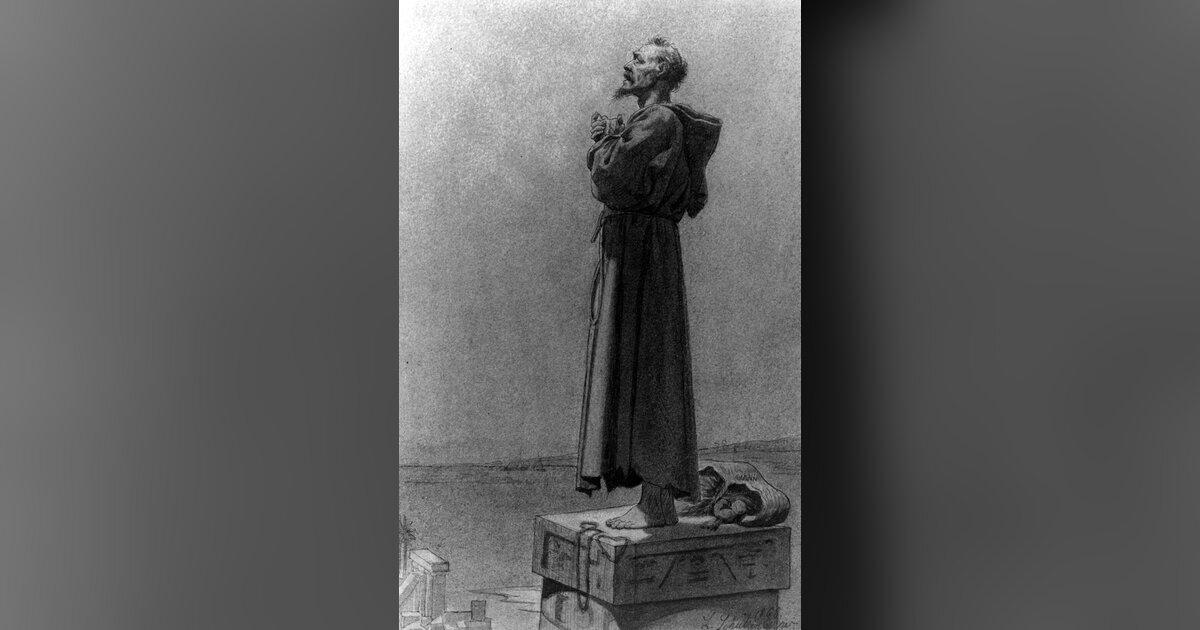
Louis-Frédéric Schützenberger, St Simeon Stylites in Egypt (1868), Walters Art Museum. Public domain, via Wikimedia Commons.

Content drones on incessant. The noise, the din, the sound and the fury.
We tap our psyche into the hive mind of humanity seeking answers, hope, fulfillment, anger, the gratficiation of our desires.
We overdose on simulacra and cry foul when our minds bend and break under the pressure.
The informational outputs of an entire world's population forced and melded into one singular consciousness. It is a surprise we have not gone mad sooner.
And yet we go on.
Complaining of the noise as we continue to scroll.
Plugging in to learn how we can unplug.
The practice makes the habit, and the habit makes the disposition.
We are fearfully and wonderfully coddled and coaxed through metamorphosis into the eternal consumer.
What do we seek from the hours of longform we fill our days and nights with?
Do we feel an interminable void within ourselves? A fathomless emptiness into which we must hurl every echo of podcast and short, so that the reverberations may coagulate into some form of satisfaction.
Anything to ward off silence, boredom, or the fear of missing out.
If we are ourselves are incomplete containers, then it is to content that we turn to bridge the gap within ourselves.
What is content?
Content is nothing in itself. It can be purely vacuous. It can be rich and lucious, bespeckled with illumination and epiphany.
Content only exists with respect to what contains it.
This term so definitive for our age can be traced to the history of the book: the Table of Contents.
The desire to provide the reader with signposts to guide them for the ideas or topics they seek to extract from the columns of slow, prodding text that confront them.
One very early example is Pliny the Elder's Natural History. Thirty seven books in total.
Well aware that no reader would want to traverse an encyclopedia front-to-back, Pliny structures Book I as a table of contents. A simple list which numbers each succeeding book and what continentur under each section.
Content in its original bookish sense functions as an abstraction to arrange and structure the material of the broader work.
Perhaps not the first, but Jacques Ellul observed that the ruthless pursuit of amplifying technological means in the modern age has become untethered from any final pursuit or goal. The means have become the end.
Content likewise has experienced a strange inversion with respect to the work that is supposed to contain it.
Can content creator culture be said to be enclosed in some broader work, corpus, oeuvre, opus?
Content creation is interminable. There is no finality in the design. One simply stops because they give up or they are dead. There is little sense that the work of online content can be completed.
This is why I would venture to say that no, digital content as it is produced today does not fall under the firm enclosing contours of the corpus. A body has definite physical boundaries through virtue of being a body. Otherwise it would be an indistinguishable morass.
Unprecedented as it is, our age is one of a near infinite ceiling for what one can produce. Generative AI has boosted this on a logarthmic order of scale. Data storage is near free for the average consumer.
With no economic or technical boundary, and the tantalizing prospects of further monetization overhead, those engaged in the online must continue to produce content, regardless of the work it is a part of.
I need not name examples, but many may remember the ongoing shift over the past ten years from structured limited series podcast or series content to the gelatinous continuity of the stream. The heavily standardized operational procedure of today's mass-market podcasts.
It never ends, and it is never meant to.
The show must go on. No matter the cost.
One could pivot thence into some distended analysis of Kafka's "The Hunger Artist".
But see, the streamer, the influencer, they have converted their way of being into a work of art. The postmodern salivates at the form-of-life. The inseparable bond of artist from art. Life from work. I have written on Agamben's meditations on this subject in my notes on The Use of Bodies.
Of course the blatant silliness of such a model emerges far too quickly, far too obviously in practice.
The mass market way-of-life will be captured by the banalities of consumerism and the ever-prodding forces of marketing.
The obscure and deranged artiste will be a plaything of the rich, a status symbol to foist around at cocktail parties. The eccentric may quite easily become celebrated or homeless, depending on the whims of the aesthetic promoter caste. The wealthy are immune to the embarrassment of their lack of taste in their desire to out-taste their rivals.
Postmodern, self-aware, self-parody, a snake swallowing its own tail.
This is the form-of-life, life as a work of art so heavily praised by the modernists onward through the midcentury.
Culture production is pressed, padded, and prodded to conform to the external patterns and pressure systems and interest groups combatting for profit, attention, and status.
A Mona Lisa could not be created today without the studio requiring a Tona Lisa sequel, premium passes, an interview circuit, and a reboot several years down the line. The work cannot be enclosed and finished but must undergo perpetual production.
Intellectual property exists for the sake of fiscal extraction at the cost of the destruction of its original environment.
One could always go monastic and withdraw from participation in the cultural production circuit that disseminates highly curated and stylized slop at remarkable velocity.
Or stick to the older epochs of media in its various forms.
But it is unfortunate that we cannot have a new work in a sense. Such a turning away is tantamount to saying we have reached the end of cultural production.
And perhaps we have. At least for now.
It is one response to salvage the shreds of psychical sanity from the dopamine farms whose pixels illuminate our homes, our hands, our bedtime routines.
The push for more is characteristic of our age. More content.
But what about less?
Prolific and voluminous authors are generally celebrated for the quantity of their output, as some kind of feat in itself.
Those acclaimed authors who write a book a year or market and sell copious volumes with soaring wordcounts and meandering yet entertaining prose.
This is fairly characterstic of certain authors in the last hundred years of literature.
Not that there is something inherently base or inferior about such a literary tack.
There is after all something immensely appealing about the thick thousand page volumes that promise to never end. There is a fun to postmodern maximalist fiction.
But such distended books and their bloat are now living past their time.
Media bloat is the disease of our age. AI slop we have to navigate and trim, written or visual or aural.
How many words do we skim of AI outputs just to find the answer we want.
What is the point of reading in the age of AI at all?
The practices of reading and media consumption are overdue for reform.
The people of the world today feel this deeply.
Understatement, economy of prose, subtlety, slowform.
It may very well be that these will dominate a new aesthetics. A form of cultural production the studio and the LLM can never emulate.
To encapsulate the meaning of the world in the size of an acorn.
I think about those authors who in short or long lives achieved immortal renown not for the digits of their word count. Nor the weight of their bibliograhic output.
The authors who wrote one, two, maybe three books. And went the way of the world.
Those who wrapped a lifetime of profundity in the smallest of poignantly crafted outputs.
John Kennedy O'Toole. Giuseppe Tomasi di Lampedusa. Even Marcel Proust.
For those and their AI agents always producing more and more. More to be consumed. More to fall by the wayside.
I think of those who in a select handful of works made their mark upon history.
Why do we need to keep filling ourselves with more and more content when we can ruminate on a finite set, one thing at a time.
There is an interminable quagmire goading our attention. That we may be spoonfed until the end.
But what of that book that we can read slowly. And in the silence that follows sit and contemplate. Without feeling the urge to stretch our finger for the next piece of media input.
The work as the antithesis of content. To keep stimulation overload in check.