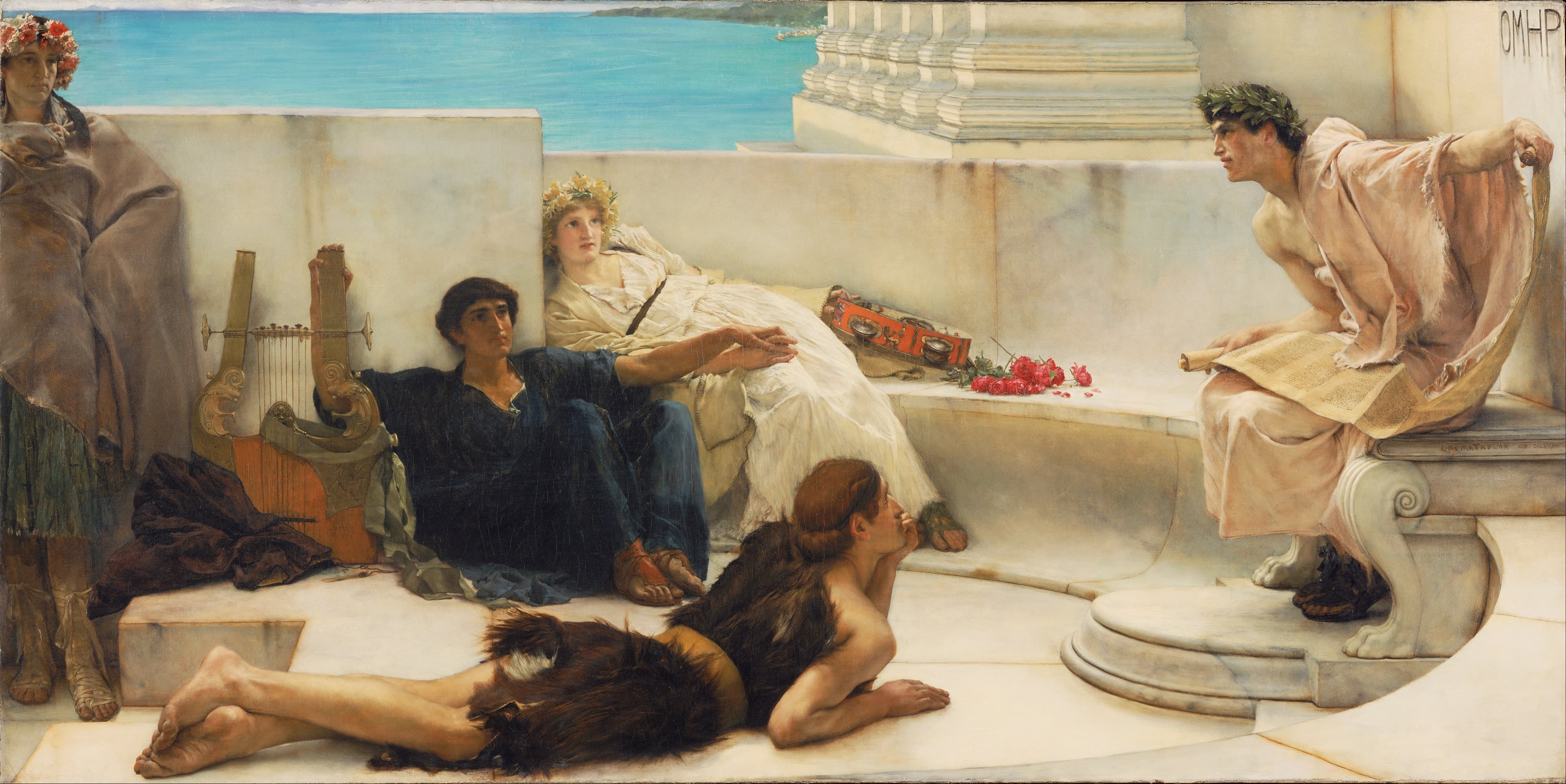
By Lawrence Alma-Tadema - fAFfW9CzajZAaA at Google Cultural Institute maximum zoom level, Public Domain, https://commons.wikimedia.org/w/index.php?curid=21886584
Attention
§1. I work with conventional AI agents every day. In the world of technology, it has been exceedingly useful to delegate time and brainpower for the mundane to AI agents. Syntax errors and complex terminal commands that once took hours to painstakingly paste together now require just one shot. Personally too, these same agents prove useful in home planning or ad hoc recipes.
And if I were to compare how much typing I do for an AI versus a human recipient (assuming of course my human recipient simply does not feed my message into their own AI), I can certainly say that I spend more time "talking" with the AI than I do my coworkers, in the completion of my tasks.
This of course is not too profound a change if the whole idea of APIs and programming is that you are inputting text-based instructions to a system that will provide you a response without human intervention.
We have simply moved the layer of abstraction just a bit further.
There are broader philosophical questions around writing and communication here.
But I would like to initiate this reflection from the standpoint of style.
In all flavors of writing, the struggle is to balance precision with economy. How many words are too many? How many too few?
We have reinvented this question around the principles of AI prompting best practices. You must provide a sufficient level of detail for your instructions to be understood. No less so for AI than human communication.
But you must also not bog down the recipient in a cumbersome morass of verbal porridge.
One must be precise in their words to achieve clarity, or deliberate ambiguity.
I do not know if even I myself pass this test, or if the pixels and ink I have spilled here and elsewhere are a net-positive force on the cosmic scale. And not just dead weight in the bourgeoning mass of words, words, wrods.
§2. For most purposes, the ideal ratio is that you use the fewest amount of words to induce the shortest level of recipient thinking to register the best reception of your message.
It is rarely useful to ennumerate an overly comprehensive range of considerations, qualification, counterpoints, and prolepses on individual questions just to ensure you get your point across.
Real or not as your loquacious points are, taken too far, this will award you epithets related to pedantry, verbosity, or just in general being a "blowhard".
Expending vast effort to render yourself logically or dialecticlaly immune to any unfavorable response is one fast way to ensure you remain unheard by those uninvested in the topic you treat.
The mind craves simplicity. To shortcut the circuitous, uncertain labyrinth of thought and find a reasonable conclusion with minimal effort. The stereotype and the cliche were born to save the mass of humanity countless hours in countless adumbrations of the same basic ideas.
§3. The desire for theoretical simplicity is not in itself a moral failing, though it can certainly lead to it.
Today more than ever we face the most aggressive and intrusive efforts to compete, divide, and capture our attention.
The finite cerebral budget of our day is cut up into an ever accumulating array of systems, products, initiatives, memes, among the other noise we ardently try to block out. Pressing and clawing ever more heavily at you, seeking their pound of flesh from your brain.
As the scope and scale of cares and concerns continues to expand, the individual is increasingly forced into a position of attentional defense.
How do you protect what little attention we have from the world outside, clamoring to get in?
Industries and influencers have emerged to capture this market segment, introducing their own noise in peddling their strategies and solutions.
The desire to avoid true, hard thinking can become a moral failing though at the point of surrender. If in light of this onslaught, you merely give up any attempt to conserve for yourself attentional capacity, consigning yourself like a passive pigskin to be shuttled around by the heavyweights of the attention economy, you are failing your obligation as a free agent.
To be a free agent, you must be able to think, and to be able to think you must be able to focus on one particular delimited section of thought. Focus that can sustain the forces that attempt to rip thought out of reflection and force it along the dopamine circuit of neural overcharge.
This requires you to be deliberate. To deliberately ignore the attention-attracting phenomena of our world. The bells, whistles, and shiny objects that flood our horizon of everyday life.
You must strive to be ignorant of all that lies outside the horizons of your clearly delineated task of thought. That is the nature of focus.
Fostering a high "signal-noise" ratio is an implicit skill, requiring judgment or sophrosyne to distinguish between the wheat and the chaff. What is signal at one time may be noise at another and vice versa. It will depend upon the task at hand, the context of the moment, and your personal constitution.
Your six year old for example, would find the writings of Nietzsche to be mere noise, at least at this time. (They should be reading Plato instead.) Give it a few years and Nietzsche may in time become signal. Or he may not.
A Preamble into Media Ecology
§4. So because there is a moral imperative to ignore those volleys and swarms of words and sounds that barrage you everyday, the converse question for the communicator then becomes: what is it to be heard?
You may emit some communicative content through words or images, visually or orally. But how do you help ensure it lands? How do you promote its reception into the minds of the audience?
We may first consider this question tangentially through Marshall MacLuhan and the realm of media ecology.
In earlier times, the reach of one's word was far more constrained than today.
It is one thing to shout your hot take from the town square. It is another for it to take the world by storm.
What could you do to improve the reach and the retention of your message?
In a pre-literate age, if you had the ethos of a sage, aphorisms could be finely crafted into teachings, but these would have fairly local and limited reach unless you were one of the greatest of all time. And even then the time for such reach to be established would be far after your lifetime.
Poetry was a tool to fairly reliably preserve your message and ensure you were repeated ad infinitum through oral performances after your death.
If you had power, you could dispatch heralds and proclamation to ensure your word was heard, but even then it was contingent upon the lifespan of your power and your continued desire to uphold the proclamation over time.
Literacy is an initial exponential bump in the power of dissemination which grew as book technology evolved toward both material longevity and ease of replicability.
Early literacy was reserved for the few, and the fact that something was written indicated that it was true, safeguarded by the wise minds who would selectively filter what was worth writing down to convey to future generations. Hence the power with which the New Testament would cite the Old Testament by saying "it is written" (γέγραπται). The present passive indicates that is something that lives to our time, it does not die the moment "it was written". It remains written.
Of course literacy faces its own limitations. The latency of replication and spread and acceptance. The time factor for these things would entail that even the basic assertions you may have made would be disputed ad nauseam by monks living centuries after your death.
The printing press is a radical factor to condense and crunch the time requirements around getting your ideas out there, especially with the rise of pamphlet culture and textbooks with the Reformation. Arguments and responses were distributed across all Europe in matters of weeks, rather than years.
New technologies would continue to expand the modes and extent of one's communicative reach. The telegraph, radio, television all with their respective tradeoffs in terms of message length, expense, and barrier to entry.
And the key to consider here is just how easy or difficult it was to make use of these mechanisms. One could not simply just purchase a printing press or a radio station. There were social and financial gateways and often editorial filters that controlled what you were able to convey even when wielding these radically impressive media technologies.
It was always the few broadcasting to the many.
This would change in our lifetime with the advent of the public Internet.
While many media technologies could point toward a general trend of information democratization (and others away from), the Internet and its subsequent advances have made a truly unthinkable project reality: the universal accessibility of all forms of broadcasting at virtually no expense.
We live in an age where there is almost nothing logistically blocking an individual from spinning up their own media empire from scratch whether that be written, visual, or oral content and transmitting it instantly to a global audience. At almost no expense.
We no longer await the hands of couriers nor the clanking of printing presses nor the passage of ships across the ocean. Much can be said on the loss of slow media but that is for another time.
And most recently, we have witnessed an even more unthinkable development: one no longer has to be human to broadcast content globally.
The Advent of AI
§5. Now we enter this most new world of generative AI.
While it felt overwhelming to be flooded by the content of every other human on the planet, we are now exposed to a new factory of scale through the proliferation of AI agents and AI-generated content.
Death of the author takes on a whole new meaning here. If the anxiety of influence was tied to human authors and mentors, how much more so should we worry as the LLM takes upon itself the ability to generate text that you as human merely consume. At least the predecessing search engine would point to human-authored content.
If one could argue that the democratization of media content also leads to its banalization (we can think of the most common uses of photography, videography, and writing in the world of social media as opposed to the early twentieth century), then the introduction of generative AI has decisively tipped the volume of content in favor of mediocrity.
As many machine learning specialists have pointed out, LLM technology is fundamentally mimetic. It takes its inputs and aggregates the mean. If models are trained off the Internet, insofar as the scales are not tipped on how they process this information, they will produce an imitation of the average Internet opinion.
The Reddit hive mind attains what is probably the closest it could ever come to in terms of discrete consciousness. Mediocrity copied from mediocrity.
The future of AI faces an identity crisis on this front. If the AI is trained out the entirety of the Internet from a pre-AI era before the Internet was flooded with AI content, how can the AI be trained on the Internet moving forward as AI-generated content grows toward a controlling interest of everything stored online. We are reaching a new genus of Baudrillard's simulacrum.
Anyone who has played around enough to see how AI agents ingest one another's messages and compoun each other's hallucinations, can only see how AI responses could only grow more vacuous, superficial, and inaccurate as time goes on. Which is why we may see more of a trend toward technocratic/expert-driven AI models. So that now the knowledge of AI is dictated down by the experts of the ecclesial hierarchy of big tech's choosing. Who can speak ex cathedra to dictate the knowledge of Claude or ChatGPT?
The sources and distillation of knowledge remain impenetrable to us the public. If the nature of critique is to consider the source, our knowledge remains subject to the will of institutional authorities.
The debate of the Reformation is born again.
§6. That is one path for AI. But what of our path?
I present these preliminary considerations to zero in on the question, "how can one be heard".
I have written before that my work on this website has primarily been intended to be expressive rather than didactic. Outreach or reception has not been my concern up to this point. But of course friends who do chance upon my website every so often, will ask if I ever intend something else with what I write. It is a lot of time to expend, sculpting a mountain face that perhaps no one will ever see. Churning out prolegomena that never get around to a "final product".
And I do not begrudge them if they to visit this site out of amicable goodwill and their curiosity is immediately extinguished by the walls of poorly edited prose, forcing them to promptly close the browser tab and increment my website bounce rate by one.
But when I have received these questions, it does make me think more critically about how one can even be heard at all, starting from scratch, in the world of podcasts, Substack, and now AI slop. Especially as many who wish themselves to be lauded intellectuals commit the Faustian pact with AI and hope that AI-generated writing will give them the sufficiently algorithmically saavy voice to themselves be heard on topics or questions they wish to be seen as experts on. Losing their own authorial voice or opportunity for growth in the process.
The desire for recognition is the root of many sins. We all must fight the compromises it tempts us toward, ineluctable as they may feel.
But this does not mean we must or should lock ourselves into a solipsistic echo chamber of one.
We want to communicate something that after it traverses information network, it is received and in fact understood by at least one recipient.
What Is an Audience?
§7. We get to the question by defining the object. Who is the intended recipient?
The method and contents of the communication must be shaped by the audience that is to receive it.
Antiquity poured fortunes into unpacking the art of persuasion through the academies of rhetoric.
If you wish to write ideas, but you only require for it to be read and understood by one individual, then you can at least in theory exert a considerable amount of skill in the personalization of the message to help effect its reception by your audience of one. Spoken conversation is our most common instrument for this. The many ways spouses manipulate one another into desired behavior.
On one view, this is not very scalable if you tried to recycle the same message at a particular or universal level. Spouse pet names often do not fly at the DMV. And you would hope that they do not either.
On another view, it could in fact be very scalable even if unintentionally so. Seneca's letters were written privately to an audience of one, but even so the epistolary form is one which can be transmitted to a broad number of interested readers while feigning some degree of particularity and privacy. Hence Samuel Richardson and the age of the epistolary "novel".
Or one could think of confessional literature which can be explicitly marked for God or oneself but may be implicitly coded for public distribution. Who is the autobiography really for?
Even then we get to the brunt of the question of why many take up writing as a task.
They wish to write to a general audience. Strangers who share some intellectual, artistic, or practical affinity for the subject matter and who are drawn to this particular author's work through virtue of the content's illuminating character. It must resonate.
This does not mean the audience is universal. If any message can in fact have a universal audience.
But it transcends one particular group who swap around what they fancy to be their esoteric notes or sketches among their own Gnostic elite and is distributable among a broader network, whomever that may entail.
Depending on how you align the stars, it could capture one or multiple interest groups as well.
Like the speaker, the writer wants to see themselves heard in the minds and the cheers (or even boos) of the many.
There are of course other kinds of audiences to consider, but this is the one we were inevitably getting at in this kind of essay.
§8. We can find a precursor for the author celebre in the example of Desiderius Erasmus.
Born out of ignominious wedlock in the fifteenth century, Erasmus became of the face of the new humanist learning in the Northern Renaissance. While conventional stereotype equates humanist intellectuals with trust fund children of nobility, Erasmus is a remarkable example of working himself from nothing into the most celebrated thinker for a time.
Milking the opportunities of a harsh, ascetic education, Erasmus accrued immense linguistic and scholarly discipline. However too much of a gourmand and aesthete for the monastic way, he fled the enclave to pursue a life of independent scholarship.
Erasmus wrote and wrote, working with printers to publish his work. Many of his first works and editions landed with little attention or fanfare.
His itinerant lifestyle and accumulations of connections and friends would allow him to get by for quite some time though as he continued to work and publish. During these uncertain years his repeated efforts to secure a wealthy patron seemed to fall through for one reason or another. But he would still get by.
It was only at the age of forty-five that Erasmus would reach international acclaim through the first edition of In Praise of Folly, both to his surprise and mild dismay that this was his true bestseller.
His earlier works would gain popularity as well, and as much as it could be said of anyone, Erasmus had a true audience even as his humanist and moderate tendencies would sideline him with the onslaught of the Reformation.
This is the model the practicing writer may live by when seeking through their own merit and discipline to build an audience and win renown.
The question is if such a rags-to-riches story which was possible in the age of humanism is possible in today's media landscape. Arguments can be made both ways.
A Web 2.0 Post Mortem
§9. What a cacophany when the nations rage. How much more so when the rage of nations is disseminated on a global scale.
How does one establish an audience-author relationship in all this noise?
From a very high level, let us consider two primary platforms that dominate the Internet spaces of text: Substack and Twitter (latterly known as X).
I have nothing original to say about Twitter here, but let us still jog some basic observations about it.
Twitter was a radically unique platform to emerge alongside the oligopolic contenders of Web 2.0 as the Obama presidency advanced in years.
Its unique structure up until fairly recently featured two primary constraints: (1) the character limit and (2) the infinite scroll.
If you did not possess the external advantages of public recognition or bot manipulation, your primary currency was poetic economy.
Each tweet like a magical incantation had to be the perfect arrangement of words, sufficiently witty, clever, insightful, or jarring that it invoked the power to upgrade from an impression to a response. Engagement is the fuel of a positive feedback loop by which one can soar to global prominence, if positioned right.
This is the air we breathe now but let us not forget how novel this was fifteen years ago. Now we all think like marketers.
This constraint existed alongside the timeline. Your precious aphorism was at the mercy of stubby swiping fingers, eyes that may glaze over your profundity in favor of that cheap GIF you were unfairly slotted next to by the arbitration of an impersonal algorithm, subject to no theodicy.
Unlike web pages or the blogosphere at the time which could live in the relative comfort of an isolated ecosystem where your reader's attention could be as concentrated as the limits of their device's RAM could allow, Twitter produces a market of constant competition where "content" exists with razor-thin walls. That audience you seek was never more at risk to be distracted into someone else's stream and lost to you forever.
Hence the renaissance of the email newsletter as a more concrete form of audience capture, if you could sufficiently tease their cursor to click through the right boxes on a sign up form.
But to enter the fray is disorienting. Like a public forum where hundreds of speakers standing side-by-side are all frantically talking and gesturing at the same time.
It is a pitiful position to be in either as a spectator or a speaker.
And Twitter played a uniquely monopolistic force in the shaping of textual, public discourse, even as Facebook dwindled and decreased on this front in the late 2010s.
It is a marvel in some ways to think about how some broadcast news and comedy show segments began to be dedicated exclusively to the reading of tweets. As if in deference to what they recognize as the new fount of knowledge.
§10. Substack came later. The logical extension of Twitter's structure beyond microposting to all information in general.
Substack is all things to all people now for all manner of content, but its original value proposition in the late 2010s was to offer managed newsletter services.
Twitter remained deliberately lean in its feature set and many users sought tools to better retain and groom their audience. To build cross-platform resiliency.
As we have already mentioned, the newsletter put up better soundproofing so that your voice was at less risk of being drowned out by competitors in a doomscroll environment. But how could you effectively and conveniently build an audience as one of these "creators" including email list management and billing without having to jump the hoops of B2B tooling?
Substack was the answer to that. And as it gained widespread adoption through the Covid era it has increasingly branched out to market itself as a shortform, longform, videofrom, audioform all-encompassing platform for content and audience management. So successful alongside the rise of TikTok that speculation only grows that Substack will come to replace Spotify and the traditional music label industry.
Of course Twitter has morphed into many things in the past couple years, and now Twitter and Substack are incongruous reflections of one another in many ways. Does it matter to the sailor which is Charybdis and which is Scylla?
The critical thing is that we now have a centralized, extremely competitive platform for not just quips and witticisms, but for all written content of varying lengths.
One could ruminate long and hard on Substack as the death of the book. If this were the end of history.
It still surprises me how many world-renowned authors and scholars day-by-day willingly embrace the saddle of Substack. Voluntary domestication. It is not safe enough outside its cozy walls anymore.
The distance between author and audience continues to shrink, and one should not overlook that loss.
Now that is compounded by the infinitely bounded creativity of AI, and the proliferation of AI content as if it now is the true pilot of consciousness.
Longform in the Attention Economy
§11. If the history lesson is merely a bore, let us bring it a close.
We are here to consider the question of author and audience in today's world.
The email newsletter was the escape route from Twitter. But now the email newsletter lives inside Substack.
Do you submit yourself totum factum to the dictates of Substack and its arbitration over your intellect? Do you accept its grammar as binding over your public existence as an author?
Life can certainly become more convenient from a logistics angle.
Exposure too is more possible. Far more eyes may glide over your writing inside the circuitry of the Substack doomscroll than chance upon it organically through the crawls of search engines, particularly if you sit on page two or three.
Such a decision should reckon the costs of willed servitude. A useful fictive exercise like the state of nature and the social contract. What freedoms we surrender when we "join" civilization and its discontents.
First we should take into account the distinction of shortform and longform textual content.
Shortform like banter arguably offers stronger value in its ephemeral nature than in chiseled aphorism.
The quip is exchanged, and everyone moves on. We forget but we remember at a deeper level. Some imprint is made.
The idea of the information hose is that by a million cuts and chips, one's mind is sculpted to have the contents and forms you desire. The plastic surgery of your consciousness under the scalpel of the algorithm. That is the social contract you as an individual work out with the platform and your content creators du jour. Is this not the vision of transhumanism?
Longform is not designed for this category of absorption. Longform is predicated upon the sustained attention and focus of the recipient. Longform relies upon the diachronic evolution of thought through the extremely one-dimensional thread of discursive writing. (The writer, like the reader, must be disciplined too in their focus.)
The essay was born out of Montaigne's attempts to work through and "test" a single idea or question, one at a time, methodically and slowly.
Longform can go beyond this to make use of stepping stones and ladders not just within a single opus but across the entire oeuvre.
Maximalist works of philosophy or literature that span thousands of pages build characters, systems, plotlines, and worlds incommunicable at the layer of pint-size text bytes.
Aggressive attention grabbers that honk your nose and move along, those do not possess the means to convey or shape at a level of sustained or systematic depth as longform.
Is it easier to prod the butts of your livestock from behind or to guide them by the head? The answer may depend.
§12. Substack is by its nature a poor home for longform. If you truly seek to realize the best of what longform has to offer.
One can go on about the marvels of plain print book technology.
Text arranged on pages surrounded by the pure milkspace of white. Nothing too pleasing to the eye as the letters blend into the words and you can glide reasonably along, moving forward or backward without the page disrupting you. (Unless you are reading metafiction like House of Leaves, a beautiful work which can serve as a healthy exercise in recognizing how jolting it is when a book outside the strict standards we are used to.)
A single sense is required. You must attune yourself to drown out the endorphin jabbers outside the strict confines of the page. Your eyes only need to belong in one place at a time and naturally progress to the next in a cinematic kaleidoscope of text. Each page belongs to itself and you must mechanically shift from one page to the next, subconsciously paginating words in your mind as well as you unfold the book unto its utter conclusion.
Many screen-based websites and applications try to mimic this, Substack is no exception, but even where there are pages versus an infinite scroll, you cannot get around the page versus the screen. Fifteen years ago when print media was supposedly on its death bed, e-reading failed to completely supplant this ancient technology.
This is not to say that e-reading has not siphoned off much of print reading's audience. Much of that is gone and that may be a good thing.
Again, some things like shortform may make more sense to consume via the screen. I personally do not exactly mourn the demise of Reader's Digest. Twitter does humor better than much of the vestiges of twentieth century media.
But there are perhaps far too many whose time budget for text consumption has shifted inexorably from the page toward the screen. They live and breathe the longform of the screen and bear its scars, shaping as it does the whole person.
§13. If you seek to build some wondrous, cumulative, maximalist work of text on Substack, you are structurally disadvantaged.
The presentation of information to you is strictly presentist in nature, even if you are shown content from weeks before. Posts and notes exist atomically and are presented as such with little coherent tension to bind different posts together like spinal vertebrae. The author can gesture internally and perhaps impotently to the rest of their corpus, but Substack and longform platforms in general do little to integrate intertextuality within a single author's bounds.
There are not so much towering edifices as the ceaseless pummeling of your psyche with rote and redundant building blocks.
The infinite timeline refuses to allow ideas to scale gracefully. The atoms of hot takes must rebound in merciless collisions off one another. The hivemind of public consciousness gropes from one commonplace to the next. It does move at least, in a sense so vague that we can safely call it Hegelian.
The reader must be deliberate in tracking down and indeed resisting dopamine sirens to peruse your history and follow you from start to finish. To do anything that is not bit-sized consumption is to go against the grain. Cal Newport and Robert Greene have remarks on focus and mastery formation that are certainly germane here.
While Nietzsche and Marcus Aurelius may have flourished in this potluck environment, Aquinas and Kant would flounder. Proust would have to vivisect his loquacious metaphors into microscopic snapshots, beautiful perhaps but still victim of radical diminution.
For those whose writing works in terms of photographs and vignettes, this may not be a problem, so long as their content is properly designed for discoverability.
But if you wish to build something more, it should not live on Substack or many of these longform platforms where you must compete for attention. Unless you are content with the costs.
Where sustained, prolonged attention and engagement with a single question may occupy books and years rather than paragraphs and minutes.
The website though not without its problems is still superior in this regard in the presentation of extended, systematic information that requires hard thinking to process.
Social media platforms of this ilk are most useful to you as pointers, hooks, and announcements that point to content that live elsewhere. But it is not to be a home where moth and dust destroy.
Generative AI as Author
§14. Let us compound this now with generative AI.
I have not done sufficient research to see if it is publicly known who is responsible for the verbosity of LLMs.
We speak often of the tokens, electricity, and climate damage wrought by AI, but we should also lament how stubbornly verbose AI models of many stripes tend to be when it comes to our time as readers.
Whether or not such design is intentional, I would label it obfuscation by pleonasm.
When trying to discern right or wrong, fact or error, you are filibustered through an excess of impeccable grammar and midwit witticism to fog the lens of your discernment. Is the AI hallucinating? It is often hard to say.
This is by design often enough.
The primary goal of AI vendor is not provide you with accurate or true information through AI conversations. The decisive metric as with social media is engagement.
AI development centers on reinforcement learning from human feedback (RLHF). The goal is to iteratively build the most psychologically addicting experience to promote user engagement.
The AI agents continuously adapt to the audiences to remain as addicting as possible, at least in theory.
And if Web 2.0 taught us anything, it is that echo chambers and confirmation bias are hormonally powerful and addicting forces.
While YouTube and Twitter have been castigated for their role in promoting confirmation bias, we have not yet begun to see widespread backlash against the AI vendors for their complicit exacerbation of the Dunning-Kruger effect.
Many professionals out there know the pain of colleagues or supervisors who fact-check your area of expertise exclusively through generative AI. Even when such AI is either subtly or blatantly wrong but certainly verbose enough to pretend it is right.
Yet as AI consumers, many readers show a statistically highly inflated sense of self-certainty.
The self-doubt necessary for thought has been extirpated. In the name of promulgating AI addiction.
Not to mention the reckless bastardization of the em dash and rhetorical antithesis. Every sentence dressed up in the smarmy voice of "It's not X--it's Y." making any such grammatical construction radically unpalatable today.
But enough of that.
We have finite time. Finite brainpower. Finite attention.
The more focus we expend navigating the obstreperous outputs of our AI companions, the less brainpower we have for other matters. It confuses our attention.
Now we see AI content presented alongside human content as if the two are equivalent through virtue of their form.
This applies not only to text of course but to all forms of media. Even print newspaper now include typographic errors of AI prompts the editor forgot to subtract.
And if I may safely assert that the content and style of AI generation will always reduce us to the mean of the bell curve, we encounter a new encumbrance that prevents us from ascending the road of mastery.
A new set of skills is required to navigate this sphere both as reader and writer.
For if in previous ages of information war and competition, your opponents were constrained by the factors of literate human scale, the AI industry faces near limitless potential to exponentially outpace you.
§15. The judicious reader will have their own tactics to combat the stultifying noise of generative AI. But here we consider the question of the writer.
If you are writing to build a general audience, you must layer this new cybernetic constellation of consumer as human and AI. This is merely an evolution of how one would layer their writing for both the human reader and the search engine crawler through SEO.
How you write is another question.
First, let us address the elephant of those who believe that they can be writers even their AI generates all the text.
If your ambition is rest upon the shadow writer laurels of your AI assistant where you serve primarily as an editor and you intend to write for a human audience, it is worth considering these questions:
- What should make your audience take you seriously? AI conversations are ephemeral, fickle creatures. What is to prevent your writing from quick obsolescence? LLM models come and go. Will a new release render your previous output irrelevant?
- What is to prevent the reader from receiving the same set of ideas and writing through the filter of their own AI assistant? If your unique value is in your system prompts then your value proposition lies in the AI Agent Marketplace, rather than on the level of outputs.
- What is to prevent the reader from inserting your writing into the Mobius strip of AI critique? AI responding to itself ad infinitum? Ostensibly you are doing this to your own AI writing, but what defines the terminal end point where the AI content has reached the point of perfection? Dialectic immunity against a matrix of LLM models and custom agents who serve as your reviewer fleet?
- Do you still see yourself as "author" of these writings? This is the question of ghostwriting in general, but one you must wrestle with.
I would contend that AI-generated writing shifts the human role from writer to editor.
You operate as a literary agent/manager or information broker. You engineer the system prompts and context but you cannot claim sufficient authorial credit for these outputs in a traditional sense.
As AI-watermarking and human-certifiability grows more common, you may find yourself facing a market system increasingly hostile to the tactics you employ to pursue your writerly ambitions.*
Or perhaps AI literature is here to stay and it will gain polish and general acceptance. Perhaps your AI content gains a following in its own right.
Another question then. Do you allow your own intellect and writing skills to atrophy and decay? Have you surrendered the freedoms of literacy to a computational process that may easily supplant you?
If you deem such questions pointless hand-wringing in the hustle of ideas, then one last point.
The more you leverage AI to write for you, the more you risk it discrediting your ethos. What respect is there for the Wizard of Oz when he is but a man behind a curtain?
The Luddite may lose on this point in the spirit of the Zeitgeist but for those who "win", it will come at a cost.
So it goes for AI-to-human writing.
If however you use AI to intentionally write for an AI audience you are engaged in a more interesting project. One more transhumanist in focus and vision. You and your fellow practitioners are building the machines to render obsolete human writing and ideas altogether. We exist for the machines, the slave-master dialectic receives its flip.
The role of humans in the circulation and evolution of ideas will certainly be reduced in such an ecosystem. And that may perhaps be the intent, dystopian as it may sound. So long as you are aware of it.
§16. Now let us say you do not wish to delegate the painstaking work of mechanical keyboard input to an entity without the fingers to experience carpal tunnel syndrome.
You yourself through a direct manipulation of pen or keys stamp out one letter at a time. You write.
How do you take the stance of John Henry and force your ideas through the noise of man or machine?
The output of AI will always outwrite you in terms of length and breadth.
But as the distinctively monochromatic style of the LLM grows dull to the eyes, so too can your style counterbalance that of the AI through soothing poise and economy.
Crisp, rich writing to offset the vacuous gloss of ChatGPT.
Participating in the joys of cryptic phraseology.
An analogy on this note.
The teleological argument for God's existence points to the marvel of eye and optics and asks the question how Darwinism can justify the quantum leap of vision from the incrementalism of natural selection.
Find your leaps and bounds that exist a qualitative tier or two above what the AI can produce in its aggregate regurgitations of the mean.
Metaphors and expressions that elude the comprehension of the mime.
Strong writers need not fear as they already set themselves apart in this regard.
Take an excerpt from Ezra Pound or (with sufficient courage) from Finnegan's Wake and realize the distinction is far more qualitative than quantitative.
If the content and depths of one's ideas are contingent upon the LLM model, they must always remain anxious. For the model may always be stripped away or replaced or obsoleced.
Your writing is not your own. It is a SaaS subscription, a lease which may always be terminated.
The parthenogensis of ideas is best understood through German Idealism, Stendhal, or Proust, at least in the Western canon.
Read them and realize LLM technology gives you nothing to fear in the world of ideas. At least in a for-itself sense.
This is not to say that perhaps another AGI leap is on the horizon, but we are hitting a local limit with the underlying mechanism of LLMs.
And as the mountain of slop grows, so too will the human desire for that which is authentically human. The market and the algorithm may correct for that in due time too.
The Audience: Redux
§17. The presumption of this essay is that you are seeking to scale an audience from zero to one through Internet means.
What we have of course neglected to mention are peer networks and communities as paths to horizontal discoverability. To participate in a community rather than bowling alone as a content creator. These ideally are more local than digital, but at the same time beggars cannot be choosers. We live in an age where virtual psuedo-communities are possible when for many ages artist communes required a great deal of effort and initiative to even get folks talking in a single locale.
You could also build your platform through traditional institutions. If the digital platforms are not able to sufficiently constrain or limit AI generated content, I feel that we may see a slight resurgence in traditional institutions of learning or communication.
The authenticity of ideas will acquire fresh luster, at least for some, if not for all.
Writing programs, publishing houses, journals, media organizations, seminaries, etc. all still exist even if the public imagination acts like TikTok clocked them out.
While I would not encourage someone go to seminary and become a pastor for the sake of expositing your own views, nor would I encourage those of finite means to expend vast sums on graduate programs to ingratiate themselves in the credentialed network, there do remain avenues for partial engagement and promotion through these venues, even if the scene is remarkably competitive.
Elite overproduction is the burden of our times. We have never had so many people in the world who consider themselves literati. It is why Sloterdijk labels the educational projects of the Enlightenment an "oversuccess".
We also should not forget that many forgettable thinkers, speakers, and writers lived in times before ours. We just never hear about them. Some are permanently lost.
The ones we hear about are the ones who managed to imprint upon their audience, even if after their lifetime.
And in all honesty this is never something that one can engineer start to finish.
Artists with resources to push their product may very well vanish from the anthologies of the next generation.
But this is not up to us to decide.
§18. I am not an embittered writer. Or perhaps I am a deeply closeted one?
I recognize the above observations could be seen as the proverbial "cope and seethe" of someone who has failed to procure widespread attention. I write as an actor may perform in an empty auditorium.
But that has not been the purpose for me. I write here on this site to put ideas out there, and if by some miraculous means someone finds it of value (if they find it at all), then good on ya.
Given these reflections, I have never really been an avid participant of either Twitter or Substack. I do not even have a Twitter account. Substack is my bellwether for friends or living authors I've read.
I do not know under what circumstances I would even try to present AI-generated writings under my own name. Given the reasons above. And I hope that the one virtue of the unevenness of my style is its denotation of authenticity.
That may change. Perhaps I will crave stardom and then slowly marinade into the bitterness of obscurity. Which I can console myself is perhaps safer than the bitterness of celebrity which has its own entrapments.
And perhaps that may be an encouraging thought to you as well, dear reader, to live in forgettable ignominy.
- And it seems that two months after I wrote this, YouTube does seem to be rolling out this kind of watermarking function.