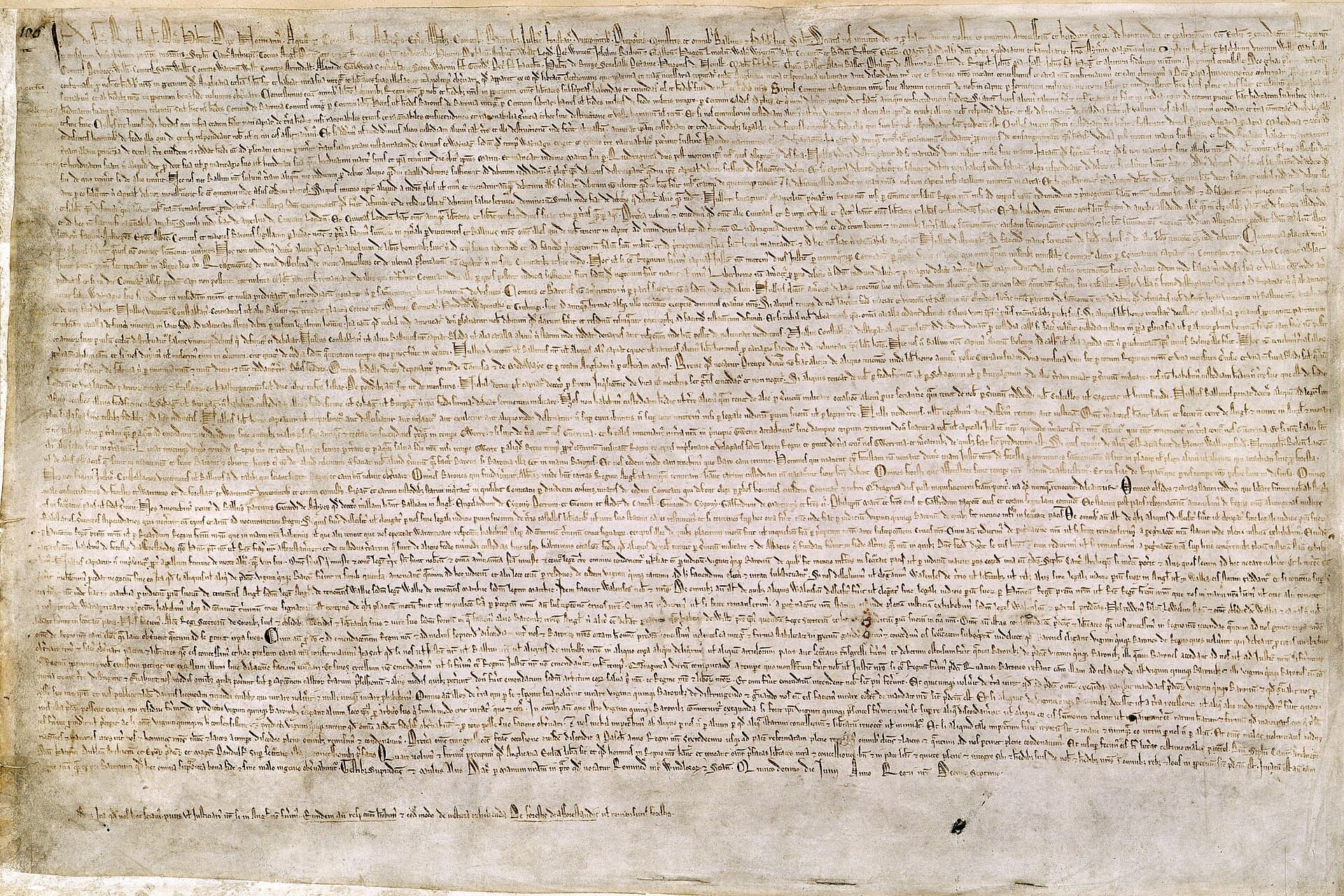
Original authors were the barons and King John of England. Uploaded by Earthsound., Public domain, via Wikimedia Commons.
.jpg)
There is, or at least has been, a certain degree of pride attached to the tradition of English common law. The liberties and protections it provides to individuals centuries before equivalent types of rights emerged on the continent.
While many begin their foray into the history of English law through Maitland's classic text, I jumped the gun a bit by skipping straight to John Hudson's The Formation of the English Common Law: Law and Society in England from King Alfred to Magna Carta, a more up-to-date survey text designed for the undergraduate.
The conventional narrative Hudson seeks to qualify is the caricature that English Common Law was born in a rather short period through the genius of Henry II Angevin and his wholesale reform of the judicial system.
Hudson does not seek to disqualify the oversized impact Henry II had on the overhaul of the royal judiciary, but he does seek to underscore the extent to which various facets and features of Angevin law can be found in early Anglo-Norman and even Anglo-Saxon antecedents.
Much of this history of early English law is hamstrung by the lack of extant textual evidence which faces rather immense gaps from the book's starting point of King Alfred the Great until the early fourteenth century.
A space of nearly four hundred years illuminated by a chance handful of documents such as the Glanville and the Assize of Clarendon or various anecdotal records from chroniclers.
If we go back to the beginning one might ask, where does one find the law in an early medieval society?
The answer is more places than one might expect.
Long before the classic question of whether church or secular royal courts had higher authority, Anglo-Saxon society featured a variety of court systems for dispute resolution.
Depending on the nature of the disputants, the availability of justice, and their standing, a panoply of court systems lived in the patchwork political structure of pre-Norman England.
Lords and nobility held and maintained their own courts. The shires and hundreds of local communities also enforced their own opinions. And of course there were circumstances where local ecclesiastical authorities could weigh in (or feature in the dispute).
In its earliest stages, law had a relatively narrow scope of interest for dispute resolution, and this co-existed along measures for restitution such as self-help (taking violence into your own hands).
When a court system was convened it was completely legitimate to recognize combat or divine intervention as decisive for a case, and in fact often easier than trying to adjudicate witness hearsay and conflicting oaths.
Violence and property disputes were the two key domains of these earliest legal systems.
Hudson prefers not to call it criminal law because this anachronism indicates that a state authority is pursuing charges against violation of standing laws, whereas in these times matters we would now deem criminal always had to be pursued by a claimant.
The same goes for property dealings which could always be complicated by overlapping or conflicting interests between tenants and lords, church officials and elicited promises of donated land, or the forgery of written contracts.
The early systems were not devoid of measures to mitigate these complications, leveraging cirographs to certify the legitimacy of contract claims, the use of oaths, or even warranties vouchsafed by a guarantor.
However, there are characteristically entertaining medieval anecdotes of how justice could be executed. In one case, a dying man was convinced by his retinue of priests that the safety of his soul could be safeguarded by rewriting his will to donate some of his property to the local church authorities.
A chagrined heir disputed the validity of this deathbed will in court but unfortunately for him, the court deferred to the authority of the church on how to adjudicate the claim. What may not be too surprising is that the church ruled an ordeal (i.e. nothing short of a divine miracle) would need to be produced by the claimant to demonstrate that God truly favored his position.
Despite best efforts, the heir was unable to produce anything that satisfied the court to this effect and so his case was subsequently dropped and the church consolidated its hold on its newly acquired properties.
For as much as one can enjoy the technicalities of obsolete legal questions, Hudson does a solid job providing a topical treatment of both legal procedure and the operational nature of law, to the extent that one can glean so from the evidence, while also acknowledging many cases when certain observations may be purely anecdotal bias from the limited array of historical material to work with.
He also does so by rethinking rote historiographical categories that could easily be superimposed upon the subject such as sublating all the developments of medieval law to "centralization" and "rationalization".
Hudson makes a clean counter-case for interpreting the Angevin reforms of Henry II which I shall rehearse in brief summary here.
What cannot be forgotten is that Henry II inherited the throne of England following The Anarchy (1138-1153), a period of civil war, chaos, and violence which would not so deeply trouble the island again until The Wars of the Roses.
Henry II gained backing for his claim to the throne on the basis that he could enforce peace and "the king's justice" which was highly desirable at various eschelons of society where lawlessness undermined the faltering court systems at play by the Anglo-Norman period of the early twelfth century.
From the perspective of Henry II then, reform and innovations of royal justice were a legitimizing force to consolidate the Plantagenet grip on the newly gained English throne.
From the perspective of the people, the advancement and empowerment of royal justice was not an unwelcome development but indeed fostered and encouraged by local denizens and even lords, a far cry from the mythos of Robin Hood around King John I. Such a desire is common following periods of instability.
What was born out of this was a positive feedback loop for one of the first bureaucratic systems of the Kingdom of England: The Royal Justicar.
The backlog of unheard disputes from during the Anarchy required an increased allocation of personnel to the hearing and trying of cases across the kingdom.
Under the administrative genius of Walter Hubert, bureaucratic innovations in recordkeeping helped achieve a remarkable level of efficiency and normalcy in the administration of royal justice. This includes but is not limited to new legal procedures but also the standardization of writs with templated formatting and language.
Hudson argues the chief goal of such measures was not rationalization in and of itself or for the purposes of centralization, but rather for the sake of pure efficiency, given the limited budget the royal justicar operated under across such a broad swathe of land.
As this system gained traction, an increasing proportion of cases were re-routed from local justice systems to royal justice because in Hudson's view, (1) they guarantee a level of regularity and fairness that is not so certain from local authorities, (2) it appeals to an ultimate authority rather than to minor nobility that could be vetoed by major nobility, etc., and (3) it was logistically cheaper and less effort to outsource such efforts to the royal administration rather than to bootstrap one's own local legal apparatus .
Again far from resisting such efforts, as a conventional narrative may claim, the nobility at least initially welcomed these efforts as it helped secure their own territory and holdings following The Anarchy.
It was only during the reign of King John I where such royal justice became commonly perceived as suspect. (John had a much higher number of recorded interventions in legal proceedings, charging much higher fees as well.)
It is also telling that the Barons who enforced the Magna Carta sought further reform that in fact codified the relatively new royal judicial system of John's father Henry II rather than devolving or dismantling it in favor of earlier models or something more noble-driven.
Hudson argues that a large part of how English common law evolved in this regard, toward a system of royal authority guaranteeing individual liberties, was in fact no one's particular brainchild, or even something contemporaries could be cognizant of.
Due to the limited level of knowledge any particular agent would have at their disposal, it likely was not even known to many English lords that the legal authority assumed to be theirs in their own lands was passing into the hands of the king.
Or even something they may have been concerned about in the early Angevin period.
After all, what historical precedents would they refer to, either to challenge or notice this shift?
The same goes with Henry II who merely saw an effective, expanded judicial system as a return to the peaceful times of Henry I preceding the Anarchy. Perhaps he did not even regard any of his administration's work as novel.
Additionally, Henry II was surrounded by exceptionally sharp, loyal officials such as Walter Hubert whose success likely exceeded even their own imaginations as many across the land flocked to the flag of English common law.
What can be said though is that such a common law system is rather unique and does not find any correlate neighbors on the continent.
To contrast with France for example, noble privilege over haute justice codified the primacy of the nobility in administering justice throughout the Kingdom of France, up until the French Revolution.
One quite obvious reason for this is the comparative size and scale of Capetian and Valois France compared to Plantagenet England. A French common law bureaucratic system like England's in this time was logistically infeasible and quite inconsistent with its political structure as well.
It is a reminder of the humanist Francois Hotman's contention that one cannot impose a universal system of law across different peoples, as each and every nation's distinct history gives birth to its own idiosyncratic laws.
A quandary that every conqueror or imperial power has sought to overcome.