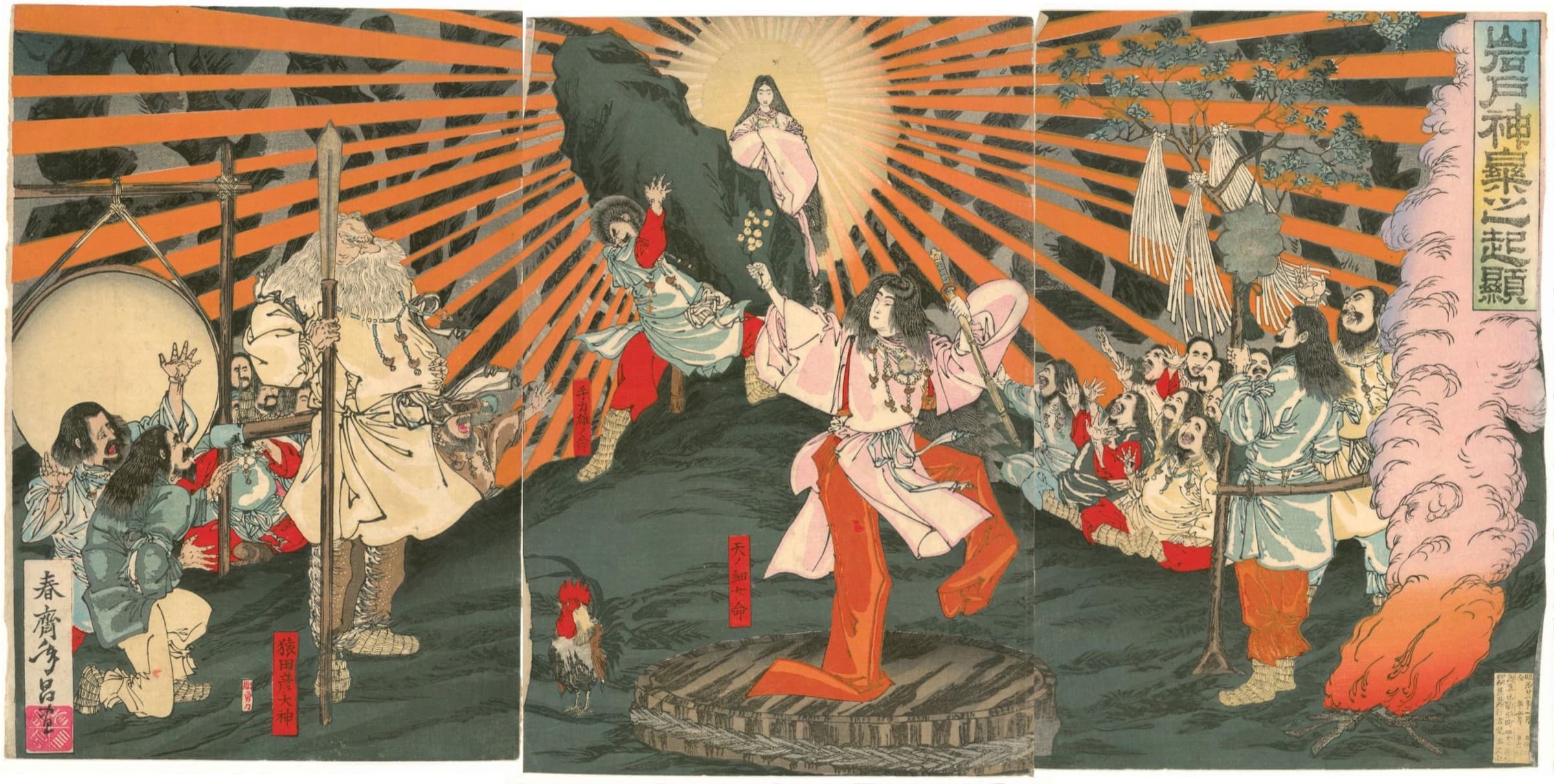
Shunsai Toshimasa, Origin of the Cave Door Dance (1889). Public domain, via Wikimedia Commons.
_by_Shunsai_Toshimasa_1889.jpg)
Mishima, Yukio. Runaway Horses. Translated by Michael Gallagher. New York: Vintage International, 1990. Originally published as Honba (Tokyo: Shinchosha, 1969).
Those who know the name of Japanese writer (or perhaps more properly artiste) Yukio Mishima may perhaps recall that on November 25th, 1970, he attempted to lead a reactionary insurrection against the government to restore Japan to its prewar greatness.
He failed to rouse the military to action after taking a commander hostage, and so committed seppuku. He was forty-five years old.
Mishima was an author who also became a movie star of sorts who then wrote a semi-autobiographical novella about being a movie star.
He wrote poetry, he adored the theater, attending even in what he described as the euphoric closing days of World War Two.
He was steeped in contemporary Western authors ranging from Thomas Mann to Oscar Wilde, but very poignantly perhaps also Nietzsche, Bataille, and even de Sade. Rankin's Mishima, Aesthetic Terrorist: An Intellectual Portrait is a fascinating read on the subject.
He is perhaps most well known for the Sea of Fertility tetralogy.
The second entry Runaway Horses (1969) details the story of a young man of the interwar period whose idealism and inner patriotic fire is disgusted with the lethargy and Westernization of Japan as a nation and people.
He is fixated upon a particular book The League of the Divine Wind. It details an uprising of men of various ages in the years following the Meiji Restoration, a reactionary uprising to restore Japan to her values. This failed uprising left survivors who variously surrendered or committed seppuku, sometimes with the aid of their family and loved ones.
The protagonist circulates this book and gathers a group of committed friends who plan to embark on the same course, so that they may restore Japan to her pure greatness.
Part of the plan is military sabotage, but a key component is the assassination of key figures including the predominant capitalist who the youth blame for corrupting Japan.
The young men fail to even get a chance to spring the rebellion as they are turned into the authorities who arrest them all.
The fourth act is an interesting trial which only momentarily waxes philosophical on the rise and fall of Japan.
Passing over the details in which a powerful benefactor gets the protagonist off the hook, he returns home to the derision of a father he considers compromised, a father who says he saw through him the entire time.
Weeks later in the deep of winter, the young man travels to a remote town where the notorious capitalist entrepreneur lives. He breaks into his home and murders him before fleeing down to the beach.
He enters a cave, positions his sword, and commits seppuku in the closing sentences of the book. The last sentence reads, "The instant that the blade tore open his flesh, the bright disk of the sun soared up and exploded behind his eyelids."
Mishima is in a sense a sui generis figure.
He is obsessed with vigor, purity, perfection, the torture of desire.
His imagery pulsates quite vividly with these forces straining within him.
Scenes of young men shirtless sweating and wrestling in the heat of summer.
The fading and decay of flower petals.
The straining of metamorphosis.
The poignant encounters of nature where soul and cosmos align in happiness, contentment, sadness, longing, or death.
There is a crisply Japanese feel to Mishima's writing.
That one must die to achieve the perfection that one must become.
Runaway Horses deals with the listlessness of young men who feel trapped by decadence and materialism. The desiccation of their society's spirit.
The loss of vitality as bureaucracy and wealth abound.
The apathy of older generations who merely chuckle or nod as they watch the old ways fade.
Young men who see no future for themselves unless they take action now.
The protagonist's counterpart is a mid-career judge. The cold, logical incarnation of reason character. Or at least that is what the narrator tells us. He is sympathetic to the younger man and expends much to save him from imprisonment or execution.
At the time, Mishima was older than even this older counterpart, and yet it is interesting he wrote this book which glorified terrorism while even yet expressing a self-awareness that it is a rash young man's game which is quite often a fruitless waste.
This is often expressed by the older characters who seem right in the end.
Even the beloved Academy of Patriotism these boys call their home is revealed to be heavily funded by the dirty money of capitalism.
Much could be said on how Mishima wrote this story of terrorism, a recipe largely of what he would go on to carry out merely a year later.
Much more could be said on those who could relate to this intense feeling in the present day. I leave that for rumination.
A Freudian slip of sorts but I find myself mixing up the title of this book with McCarthy's All the Pretty Horses.
An interesting parallel perhaps. A wandering young man seeking meaning in a world losing its wildness.
The deletrious encroachment of America and her values on a national culture crumbling before the advent of the American machine.
A balanced celebration of masculinity, ever aware of the dangers of the male drive and its advantanges.
Though not without its differences too of course.
For though you may find Nietzsche in both McCarthy and Mishima, in the former you find the cynic, in the latter you find the idealist.
The man of overcoming, driven through struggle on an upward ascent.
This you cannot escape in Mishima.
Protagonists wracked by internal tension. An intense Platonic eros to become more than who they are. To become what they are, even if death is the price.